
Leveraging the support of CERN alumni mentors
Are you in your early career? Are you searching for ways to move your career forward? Would you like to develop your skills or learn how to navigate various challenges in your workplace? Perhaps you would like to find someone who can help you do these things? This is exactly where a mentoring relationship can come in handy.
There are many benefits of being mentored by someone more experienced than you. Rather than learning alone, a mentor can accelerate your learning and development.
We talked to a couple of mentees who were mentored by CERN alumni mentors in the past thanks to the collaboration between CERN Women in Technology and the CERN Alumni programme.
We asked them not only about how having a mentor benefitted them personally, but also practical questions regarding how they organised their mentoring sessions and their advice for those considering seeking a mentor.
Here’s what they told us:
Berta Rubio Pascual
Now: Thermal Engineer at senseFly
 What made you seek mentoring and what were your expectations prior to joining?
“During my master studies I had already participated in a mentoring programme, and the experience was incredibly positive so I was eager and very grateful to have the opportunity to take part again, but this time, within the CERN context.
I was looking forward to the opportunity of learning from someone that had been in a similar position to mine in the past. I wanted to learn from their tool-kit and about the mindset they had when they faced the challenges that laid ahead of them when their CERN contract was coming to an end.”
In which areas have you progressed most thanks to having a CERN Alumni mentor and what was the biggest contribution of mentoring to your career?
“The CERN Alumni programme broadened my horizons and gave me perspective when changing jobs in the middle of a pandemic. Sometimes when you feel overwhelmed, you tend to think that your personal situation is unique, but it is amazing to see and hear others that have had the same fears and joys that you are facing. You feel very grateful when they share their thoughts with you and tell you how they have tackled similar situations.”
What did your mentoring sessions look like? What did you cover during your meetings?
“We tried to schedule one hour meetings every two weeks, but we were flexible depending on our agenda, and how the discussion went. At the beginning of the mentoring session I had outlined a series of topics I wanted to discuss, so we tried to cover one of those at each meeting.”
Do you have any best practices to share with other mentees and/or with those who are hesitant to ask a mentor for help?
“Keep an open mind and be proactive! Sometimes it can be tough to do some self-reflection and to decide which topics to discuss, but there is no better way than giving it a try. A mentoring program is a two way relationship that will allow you to explore other points of view and learn from the experiences of others in a unique way.”
Michael Wilkinson
Now: Postdoc at the University of Cincinnati working with LHCb
 What made you seek mentoring and what were your expectations prior to joining?
“I had long heard about the benefits of mentoring but wasn’t sure how to approach finding one. I was glad to have a program to help match me with someone.
I was hoping for insight about how to navigate the next part of my career. I found the conclusion of my graduate studies particularly stressful, especially given that my wife and I were expecting a baby around that time.”
In which areas have you progressed most thanks to having a CERN Alumni mentor and what was the biggest contribution of mentoring to your career?
“It came at a fortuitous time as I was trying to conclude my PhD and find a new position.
My mentor was generous with his time and helped me edit my job application materials in great detail, including my CV, cover letter, and job talk.
The WIT mentoring program was invaluable to my postdoc search. The energy and time my mentor invested in helping me proofread my applications was extremely helpful, and he was a big reason my job hunt was successful, even though whilst a CERN alumnus, he is no longer part of CERN himself.“
What did your mentoring sessions look like? What did you cover during your meetings?
“I did not know this would be the case when I applied for the program, but its beginning coincided with the start of my job application process.
Our sessions therefore focused on job application strategies and revisions to my application materials. We also talked about European football and politics.”
Do you have any best practices to share with other mentees and/or with those who are hesitant to ask a mentor for help?
“Having someone outside your program who can provide disinterested, honest feedback is invaluable. Give it some time to build a rapport with your mentor, as you both learn about each other’s situations.
It really helps to have a specific goal in mind, something that you are working toward, especially since these programs are short term.”
Alex Rollings
Now: Data Science Consultant at D ONE
 What made you seek mentoring and what were your expectations prior to joining?
“I knew that I wanted to move out of academia and into a job in data science within the Zurich area, but that’s quite a broad desire, and I wasn’t sure where to focus my job search.
Whilst I was writing my PhD thesis, I applied to the WIT@CERN mentoring program with the hope of finding a mentor who could help me to explore my options and give advice on job applications and interview preparation.”
In which areas have you progressed most thanks to having a CERN Alumni mentor and what was the biggest contribution of mentoring to your career?
“I was paired with a mentor who also lives in Zurich, and she has helped guide my job search over this past year. She has been a sounding board for my ideas, has put me in touch with people within her network who she thought it would be beneficial for me to talk to, and has helped me to learn how to effectively and thoughtfully communicate with people in the business world.
The biggest contribution to my career has been the expansion of my network that she has facilitated; she introduced me to people in professions/companies I was interested in, allowing me to explore different options before applying for a position.”
What did your mentoring sessions look like? What did you cover during your meetings?
“Our meetings have not been particularly structured, but I have appreciated the flexibility of this.
At times we went for months between meetings, whilst at others times (for example when reflecting on job interviews), only days. My mentor left it up to me to call meetings when I thought they would be beneficial and wanted her advice.
The content of the meetings themselves depended on where I was in the job search process.
At first, when I didn’t have a clear idea of what I wanted to do, we would set some tasks that I should complete before the next meeting (for example putting together a draft CV/researching companies I might be interested in). Of course this was all informal and flexible, and I could call a meeting in the meantime if something came up that I was unsure about.”
Do you have any best practices to share with other mentees and/or with those who are hesitant to ask a mentor for help?
“If someone is hesitant to ask a mentor for help, my advice would be that it can’t hurt. The relationship between mentee and mentor will only exist as long as the mentee wants it to, so if the relationship is not benefiting you, you can end your sessions together. It helped me to ask my mentor why she wanted to do the program, to understand what her motivations were. After that, I didn’t feel like I was putting her out by asking for her time because I understood that she really wanted to help.
It’s hard for me to give advice on best practices because it really depends on the personalities of the mentor/mentee, and what the mentee wants to get out of the relationship. I would just advise you to use your instincts when discussing how to structure (or not structure) the meetings: some people preferred to work more formally, meeting on a regular basis with pre-defined goals; others (myself included) preferred to meet in a more flexible way. Find what works best for you!”
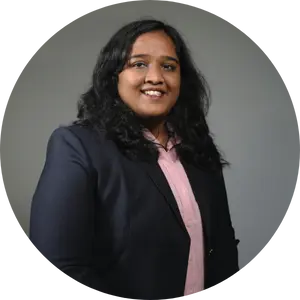
Richa Nevatia
Now: Senior Manager - Social Media and Content at SkinQ
 What made you seek mentoring and what were your expectations prior to joining?
“I was looking at starting my corporate work experience after my contract would end. I needed guidance from an experienced mentor regarding some of my problem areas in building a network, curating my CV, and needed a sounding board for planning my career. I was hoping the mentor would be able to guide me a little as an experienced person, especially a woman, working in the corporate sector.”
In which areas have you progressed most thanks to having a CERN Alumni mentor and what was the biggest contribution of mentoring to your career?
“I gained a lot of confidence thanks to my mentor. I didn't even know I was lacking in that area until my sessions with her. She helped me shed my fears of cold approaching my network for help and helped me look at things from a supervisor, and possible interviewer's perspective. This really helped me in my job interviews and my overall image projection.”
What did your mentoring sessions look like? What did you cover during your meetings?
“My mentor asked me about things I would like help with before my first meeting, which helped break the ice. In subsequent sessions, the flow of the conversation helped continue the sessions.”
Do you have any best practices to share with other mentees and/or with those who are hesitant to ask a mentor for help?
“Don't be too shy to ask anything! Your mentors are literally here to help you. Mentoring sessions are judgement free, and if you share your concerns, you will put the mentor in the best possible position to help you.”
You heard it. Mentoring can be a very powerful tool and has the potential to help shape your career and professional development. It can be as flexible or as structured as you want it to be and it can target the exact goals that you set for yourself.
In conclusion and quoting Alex when she evaluated the mentoring program and her collaboration with a CERN alumni mentor, she stated: “The WIT mentoring program and CERN alumni network in general has been the single biggest help for me during my career move out of academia and into industry. I would advise anyone in a similar position to make the most of this fantastic network of good-willed people!”
If you want to try mentoring yourself, you can find an updated list of available CERN alumni mentors on our community platform: https://alumni.cern/page/mentoring-hub
Checklist to start your mentor/mentee relationship:
- Update your profile on alumni.cern so that your mentor is familiar with your background and where are you currently working/studying,
- Find your mentor on https://alumni.cern/mentoring/378/mentors based on the skills or areas you want to focus on,
- Contact your mentor by clicking on “Connect” and sending them an accompanying message explaining what you hope to achieve by being in a mentoring relationship with them.
We wish you the best of luck and we are available in case you need any support or have questions: [email protected] and look forward to hearing your feedback.