
Where Curiosity Leads: CERN Alumnae Shaping Tomorrow’s Technologies
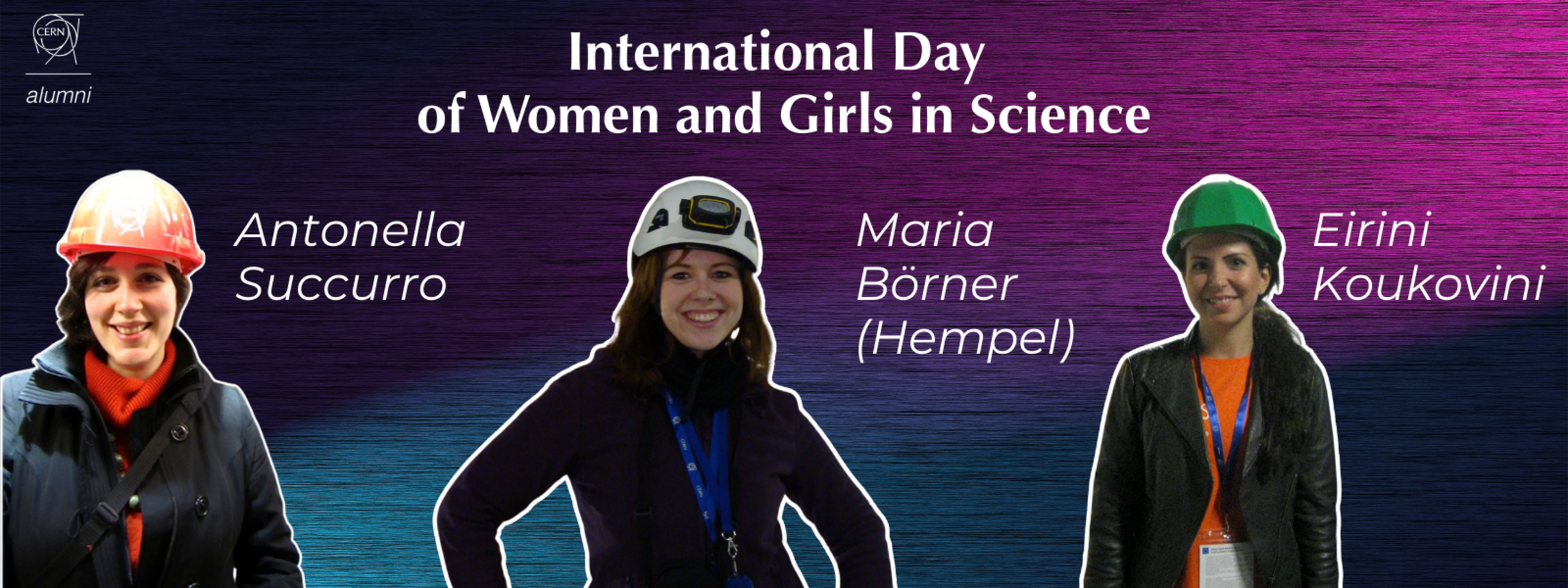
Every year on 11 February, the International Day of Women and Girls in Science celebrates the vital role women play in research, innovation and technological progress — and the many ways science shapes our societies.
Yet this contribution remains unevenly represented. Despite decades of progress, women still account for only around one in three researchers worldwide, and a similar proportion of graduates in science, technology, engineering and mathematics.1 The question is no longer just who studies science, but who goes on to shape the technologies, policies and solutions that emerge from it.
At CERN, thousands of young scientists and engineers develop the skills, curiosity and ways of thinking that often carry them far beyond particle physics, into fields such as artificial intelligence, data science, healthcare and climate innovation.
To mark this day, we spoke with three CERN alumnae now working at the forefront of AI, data and sustainable technologies about how their time at CERN shaped them, where their curiosity has taken them, and what excites them most about the science of tomorrow.
Introduce yourself: what were you working on at CERN, and where has that curiosity taken you today?
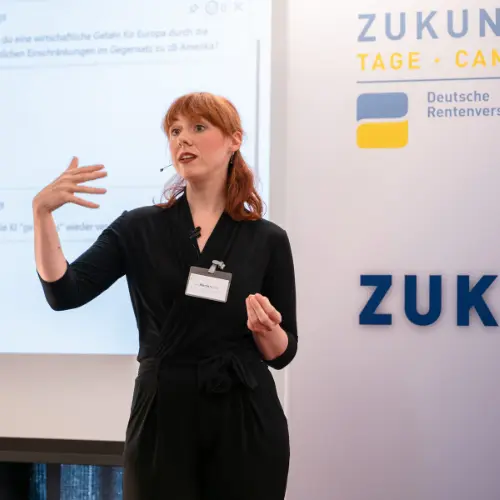
Maria Börner (Hempel)
"My name is Dr. Maria Börner, formerly Hempel. During my time at CERN, I worked as a Technical Student in the LHC Machine Group, where I was responsible for measuring beam backgrounds using diamond detectors. I continued my work with detectors and beam dynamics and did my PhD at DESY, where I measured beam background and luminosity within the CMS experiment.
Today, I work as an AI expert and Keynote speaker at Westernacher Solutions with a strong focus on business development in the field of responsible AI, and ethics. I support public-sector organisations in adopting AI in a secure, transparent, and value-driven way. I also teach colleagues about AI technology, ethical principles, regulatory frameworks, and responsible innovation. Outside of work, I volunteer for the international organisation Women in AI, where I lead the German chapter to empower and connect women in the field of artificial intelligence."
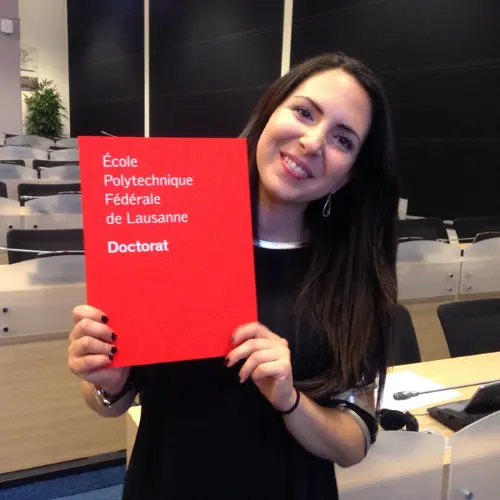
Eirini Koukovini
"Hi, I'm Eirini, a physicist and data scientist. My journey has been fuelled by curiosity about the universe and complex systems - from particle physics and materials to large-scale accelerators.
At CERN, I worked as a summer student, technical student, PhD candidate, and Fellow. During this time, I optimised beam quality across the PSB, PS, and SPS for the LHC injector upgrade, while studying high-frequency coatings used to enhance vacuum conditions in accelerators worldwide. This drive took me from academia into industry, where I now tackle real-world challenges with data science, most recently advancing women's health in femtech. Alongside my technical work, I am an Ambassador for Women in Data Science and help co-organise an annual data and AI conference in Geneva."
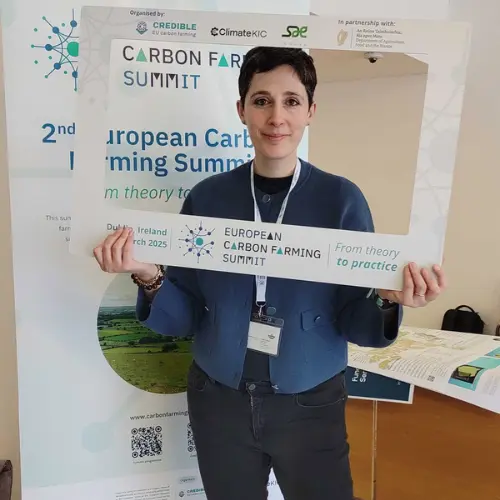
Antonella Succurro
"My name is Antonella and I was at CERN working with the ATLAS collaboration, first during my master thesis in 2009, then during my PhD between 2010 and 2014. I was working on New Physics searches, specifically Vector Like Quarks, focusing on data analysis and contributing to calibration of the Tile Calorimeter. Today, after several years doing scientific research in the field of computational biology, I am co-founder and CTO of CinSOIL GmbH, a German deepTech startup on a mission to make our agrifood system more sustainable and resilient to climate change. We leverage Earth Observation data, Artificial Intelligence and biological, process based models, to understand what happens on agricultural land and suggest the best agroecological practices to improve key sustainability metrics, such as soil organic carbon content. For the past 4 years, I have also been teaching as adjunct professor the course "Carbon sequestration and the contribution of the AgriFood sector" in the Master for AgriFood Sustainability at the University of Pavia in Italy."
Which skill or way of thinking you developed at CERN has turned out to be surprisingly useful in your current role?
Maria Börner (Hempel)
"CERN taught me to work self-organised, take responsibility, and approach challenges with the mindset that every problem has a solution. You simply have to find the right path to it.
The culture at CERN, grounded in European values such as collaboration, openness, and equality, has shaped the way I work with AI today. I learned the importance of transparent, open-source technologies and the responsibility that comes with developing systems that support people rather than harm them. These principles guide me to advocate for AI solutions that uphold human rights, ethical standards, and fairness."
Eirini Koukovini
"The biggest takeaway from CERN wasn't a single technical skill - it was a mindset: methodical, staying calm in uncertainty, exploration, and a strong can-do attitude.
Working in that fast-paced, complex world taught me to adapt quickly. In industry, it's essential for data science and career shifts, where tools evolve fast and learning never stops."
Antonella Succurro
"CERN formed my scientific and analytical mindset, which I apply on a daily basis to the multiple and varied problems I have to tackle. From the first moment I stepped into CERN, I was deeply impressed by its history and mission. This feeling, this need of doing innovation and advancing technology ,keeping the world and society in mind, has always been with me during my career development. After my PhD, I knew I wanted to work on topics addressing environmental challenges, and this is what brought me first to computational biology, and now to entrepreneurship."
You work in fields shaping how society tackles major challenges. What excites you most about the impact your work could have over the next ten years?
Maria Börner (Hempel)
"One of the greatest challenges we face today in an era of rapidly advancing technology is protecting and upholding European values such as equality, humanity, solidarity, and ethical principles. I am committed to ensuring that AI is used in ways that strengthen these values.
In the next ten years, I hope my work contributes to a world where marginalised communities become more visible, where equality is lived rather than only written in policies, and where AI development is driven not just by economic incentives but also by values, privacy, and societal impact. I am excited to help shape AI systems that truly empower people."
Eirini Koukovini
"I love data work that boosts health choices and societal good, which drew me to femtech. Working with real women's health data, I'm thrilled by evidence-based insights driving innovation.
In the next decade, I see these helping women feel truly supported through smart, tech-powered care."
Antonella Succurro
"More than excitement, I feel the pressure and urgency to act. I am also a mother, and the idea that my children might not be able to breathe clean air or eat healthy food fills me with that kind of fear that spurs me to action. This is also a reason for me to contribute to the policy discourse, for example, with my work related to the recent Carbon Farming and Carbon Removals (CRCF) Regulation. I think Europe is serious about its 2050 carbon neutrality target, and I hope it will set the example for other countries around the globe. There is no plan B afterall."
What is one unspoken rule of scientific or technical environments that took you time to learn?
Maria Börner (Hempel)
"When we are young, we often believe that everyone is treated equally, regardless of gender or background. But the reality is different. Inequality exists, and it affects careers, opportunities, and confidence in subtle and not-so-subtle ways.
The unspoken rule I had to learn was: you will not be treated equally, and you must be prepared to challenge that reality and work to change it. I wish more young women were told this early on, not to discourage them, but to empower them."
Eirini Koukovini
"Own your career - there's no preset path; spot opportunities and create them. Don't wait for a perfect fit; confidence, action, and a can-do spirit unlock opportunities. Trying, learning, and sometimes stumbling is how you grow, not a sign you don't fit in. Build networks as much as skills - they matter for visibility and support."
Antonella Succurro
"I want to tell all young women, and I wish I could tell this to my younger self: there are no stupid questions, raise your hand, you belong in that room! Too often I felt scared to ask questions or bring forward my opinion in a classroom or a meeting room full of men, doubting myself and thinking "no, this is stupid, I should not say this", just to hear my thoughts expressed later by someone else who spoke up."
If you could redesign one aspect of how scientific institutions support women and girls today, what would you change first?
Maria Börner (Hempel)
"Visibility is crucial. Growing up, the only women in physics I ever heard about were Marie Curie and Lise Meitner. When I entered university, I often questioned whether I truly belonged, whether I was “smart enough,” or whether someone who liked dresses and makeup could fit into physics at all. The few women I saw in the field didn’t look like me or live lives I could identify with.
If I could change one thing, it would be to ensure far greater visibility of diverse female role models."
Eirini Koukovini
"I'd boost support early: ongoing outreach, diverse role models, and visibility from schools on. Girls often choose science (or not) early, without real views of careers or women succeeding at every level, especially leading."
Antonella Succurro
"During my time as a researcher, even before becoming a mother myself, I have been very vocal about offering childcare support at scientific conferences and events. In the end, women and girls are fully equipped to succeed as long as the system eliminates practical barriers and makes them feel welcome. This includes highlighting more role models and ensuring more representation, which is needed not just for women but in general for all minorities that are currently underrepresented in STEM."
The thread that connects it all
CERN is not only a place where discoveries about the universe are made, it is also where future innovators, leaders, and changemakers are shaped.
Maria now works at the intersection of artificial intelligence and ethics, shaping how public institutions adopt new technologies. Eirini applies data science to women’s health, turning complex systems into practical tools for everyday decisions. Antonella builds climate solutions that connect satellites, biology and policy.
Their careers look nothing alike. What they share is a formative chapter at CERN, a place that trained them to think across complexity, work in international teams, and treat big problems as solvable.
Each of them also returns, in different ways, to the same point: visibility matters. Seeing women lead, speak, build companies and shape technology expands what feels possible — not in theory, but in practice.
This International Day of Women and Girls in Science, we celebrate the alumnae who continue to carry CERN’s spirit of curiosity, collaboration, and responsibility into the world, and the many paths that science can unlock.
Join UNESCO on 11 February
To continue this conversation, UNESCO is inviting the global community to celebrate the International Day of Women and Girls in Science with a hybrid event on Wednesday, 11 February 2026 under the theme “From Vision to Impact: Redefining STEM by Closing the Gender Gap”. The day will spotlight concrete actions and perspectives on how inclusivity enriches science and innovation across disciplines — including emerging technologies like AI and data science.
1) https://unesdoc.unesco.org/ark:/48223/pf0000393768