
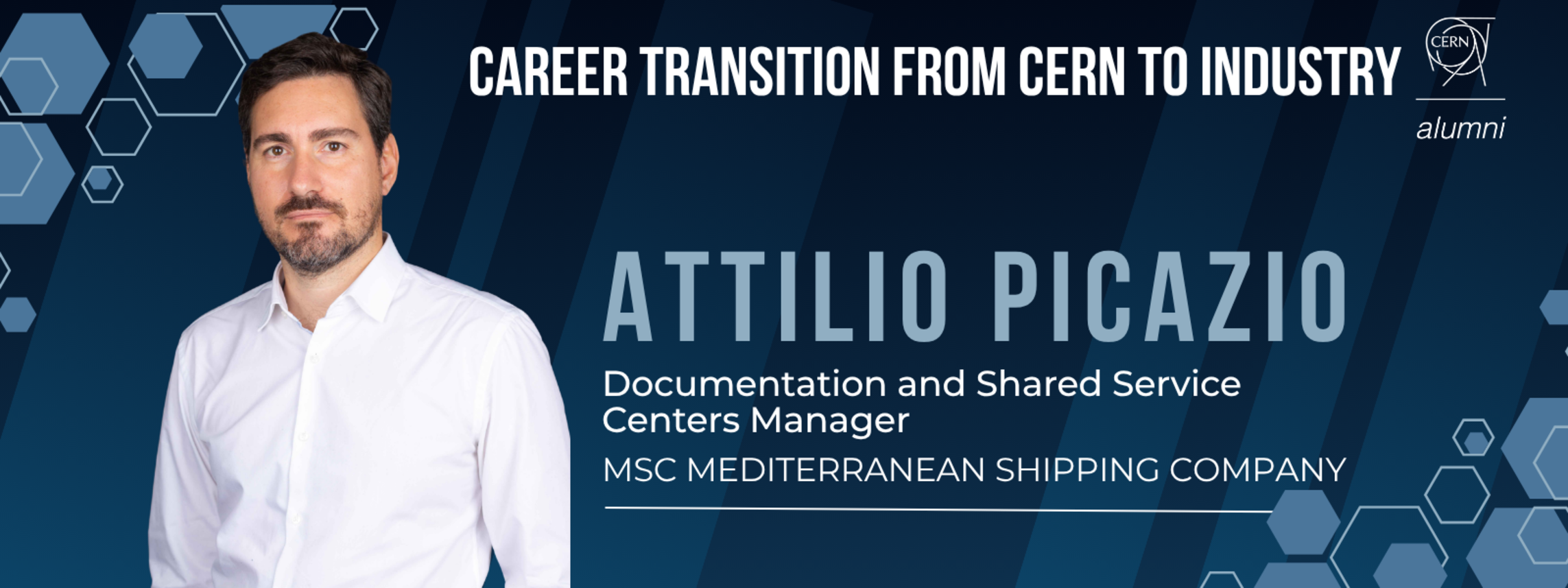
Career transition from CERN to Industry - Attilio Picazio
Moving from CERN to industry is a path many alumni have walked, but it's rarely straightforward.
How do you make your research experience resonate with a recruiter? What belongs on your CV, and what doesn't? How do you prepare for interviews where no one has heard of ROOT or GEANT4?
In this series, we ask alumni who've successfully made the transition to share what actually worked for them - practical advice on job searching, CV writing, and interview preparation, drawn from real experience.
Whether you're actively looking, just starting to think about it, or simply curious about life beyond the lab, we hope these conversations help you take your next step with confidence.
CERN Alumni: Attilio Picazio
At CERN: USER 2009 - 2020
Now: Documentation and Shared Services Centers Manager, MSC Mediterranean Shipping Company
What was your role at CERN and what are you doing now?
"I began my career as a PhD student in High Energy Physics at the University of Geneva.
In 2015, I started a postdoc at the University of Massachusetts Amherst, a role I held until leaving academia in May 2020."
What aspects of your CERN experience turned out to be the most valuable when applying for industry roles?
"Working at CERN means dealing with extreme complexity without panicking. To succeed there, you have to learn fast and adapt to every new situation—skills that stay with you in any role."
What elements are ‘must haves’ on a CV in your sector?
"Proficiency in Business Intelligence tools—specifically Excel and Power BI or Tableau—is foundational for anyone transitioning into industry-level data roles. These skills are essential additions to your CV."
What common mistakes do you see CERN people make when writing their CV?
"Never assume that HR will read between the lines. Just because you can program in Python or C++ does not mean recruiters will automatically credit you with proficiency in Excel or Power BI. If a tool isn't explicitly mentioned in your portfolio, the person reviewing your CV will likely assume you don't know it.
Your CV must be clear, keyword-rich, and tailored to the specific types of roles you are targeting. You don't necessarily need a unique CV for every single application, but it must be optimised to match the core keywords found in common job descriptions.
Including a 'Personal Interests' section can be beneficial, provided the content is engaging. It serves as an excellent icebreaker during a first face-to-face interview, helping to build rapport beyond your technical credentials."
How did you prepare for interviews outside the research environment?
"When describing your experience, prioritise brevity over verbosity. I highly recommend mastering the STAR method (Situation, Task, Action, Result) to provide structured, impactful interview answers. Most interviewers don't need every technical detail of your tasks—if they want more depth, they will ask. Focus on the results."
What advice would you give someone at CERN who is starting to explore industry jobs?
"Don’t be hesitant to announce to your network that you are seeking new opportunities. Use job descriptions and informational interviews to identify the roles that truly resonate with you. Once you’ve identified your target, tailor your CV accordingly.
If you find a skill gap, take the initiative to study and bridge that gap before applying."
What do you suggest people should start doing before leaving CERN to make the transition easier?
"Procrastination is the enemy of a successful career pivot. If you’re thinking about transitioning out of research, don't wait for a better opportunity to emerge. Start building your network and learning industry tools immediately; the best time to begin was yesterday."
What resources (people, platforms, courses, etc.) helped you the most during your job search?
"The Career Starter booklet is an absolute "gold standard" for anyone navigating the Swiss job market, especially for those coming from academic hubs like CERN or the University of Geneva. It is published annually and serves as a bridge between the university world and Swiss industry. It can be good also for someone looking for opportunities outside Switzerland."
Your turn: Made the leap from CERN to industry?
We'd love to hear what worked for you. Every career journey is different, and your story could be exactly the nudge a fellow alum needs to take their next step.
Share your experience here.
Looking for more career resources?
Head over to our Media Centre, where you'll find recordings from previous career events and resources recommended by fellow alumni.
Know of a resource that helped you and should be on the list? Let us know at [email protected], we are always looking to grow this collection for the community.