
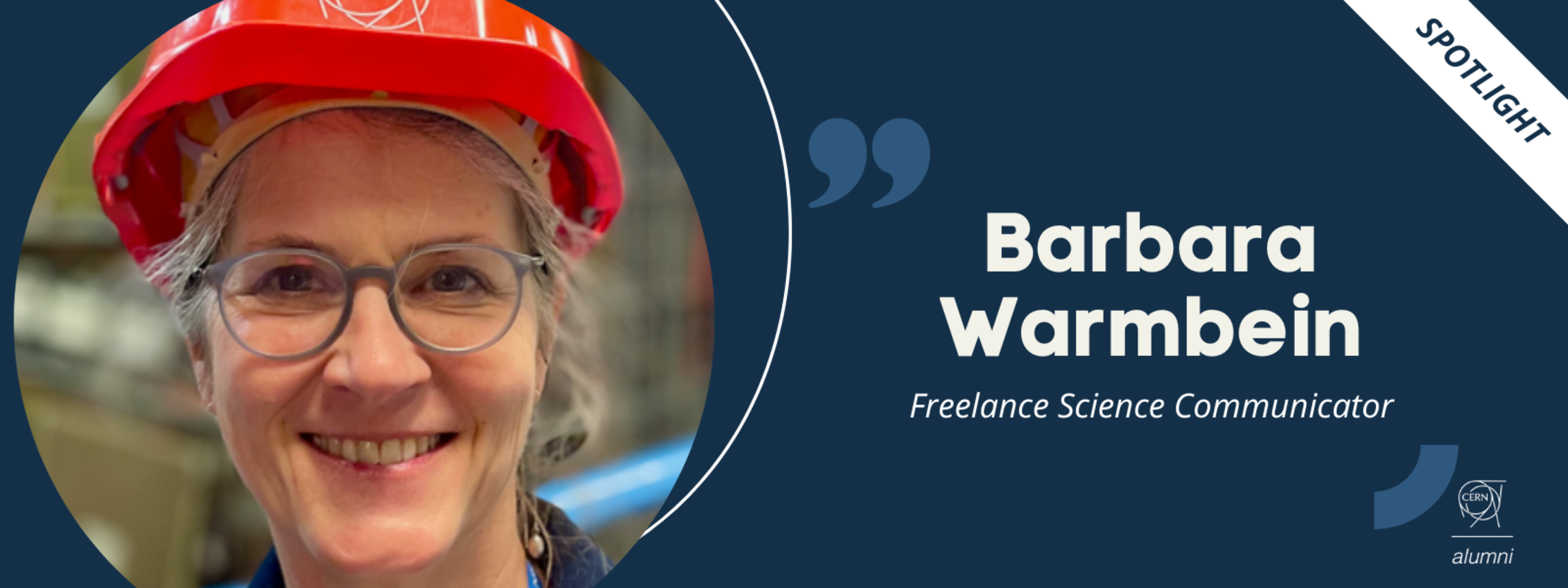
Barbara Warmbein: Finding Her Place in Particle Physics
At CERN:
Associate (01/11/1999 - 29/02/2000) & (09/09/2008 - 09/09/2016)
Other (13/03/2000 - 25/02/2001)
Now: Freelance Science Communicator
A random encounter with a physicist at a party led literature graduate Barbara Warmbein to CERN in 1999. More than two decades later, the science communicator, author and alumna reflects on how the Laboratory shaped her career, nurtured her passion for particle physics and her curiosity and taught her what people can achieve when they share a common purpose.
When Barbara arrived at CERN in November 1999, she had no intention of building a career in particle physics. A graduate of English, American and German literature and language, she had always imagined a future in writing for the cultural sector. As a student, she worked as a freelance journalist for a local newspaper and expected her professional life to revolve around theatre, literature and the arts.
“I think I wrote my first novel draft when I was nine,” she recalls. “It was only about five pages long, but writing was something I always wanted to do from then on.”
Physics, meanwhile, played only a minor role in her life. That changed unexpectedly during a conversation at a student party:
“I met a physicist who talked about particles, accelerators and detectors with such passion that I thought: this actually sounds interesting.”
At the time, Barbara had just submitted her master’s thesis and was preparing for an internship in India. Looking to fill a few months beforehand, she contacted CERN’s Press Office to ask whether an internship might be available. As it happened, a position had just opened.
Becoming part of a new world
Barbara still remembers her first impressions of CERN when she arrived:
“I drove through Meyrin on a grey November day and thought: ‘Oh gosh, this is ugly!’ I had imagined Geneva as a brighter and happier place.”
Any doubts quickly disappeared once she entered the Laboratory. More than the science itself, it was the atmosphere that left a lasting impression:
“What fascinated me was that everybody seemed to love what they were doing at CERN. A whole new world opened up, and I felt that you became part of it immediately. You were embraced. You were there for a reason and people accepted that.”
That sense of belonging remains one of the most important impressions she took away from her time within the Organization. As a student journalist in the Press Office, Barbara wrote articles for the CERN Bulletin and supported a range of communication activities, embracing the role as it was tailor-made for her. While she initially worried about her lack of scientific knowledge, she soon realised that her perspective was an advantage:
“If you want to translate something for a general audience, it actually helps not being an expert. You have to ask the questions your audience would ask.”
Over time, she came to see science communication as a two-way process, also benefiting researchers to develop their communication skills:
“It was good for scientists to think about how to explain their work, why it matters and how to make it relatable.”
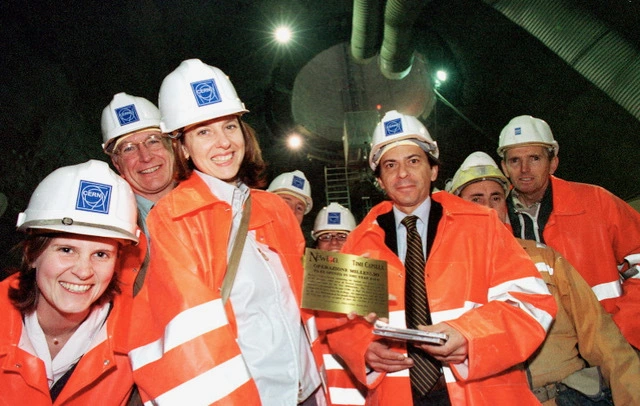
construction site in 2000
More than science
What began as a short internship developed into more than two years at CERN, including work on European physics education projects and a variety of communication initiatives. Looking back, Barbara sees CERN as the place where she discovered both her professional calling and a lifelong fascination with particle physics, fuelled by curiosity, a skill that has stayed with her ever since:
“CERN is where I fell in love with particle physics. Being there gave me a huge enthusiasm for the topic, which has stayed with me ever since.”
Throughout her subsequent career, she worked across a range of scientific fields, including photon science, accelerator technology, and space science at the European Space Agency. She later landed a job in the communications department at DESY in Germany, working on the International Linear Collider project and "Weltmaschine", the German LHC communications channel. Throughout these new positions, the spirit she first encountered at CERN remained present:
“What I really took away from CERN was this striving for a common goal, the passion for the topic, the common sense of purpose and the desire to make things happen. You can feel it across the world of particle physics.”
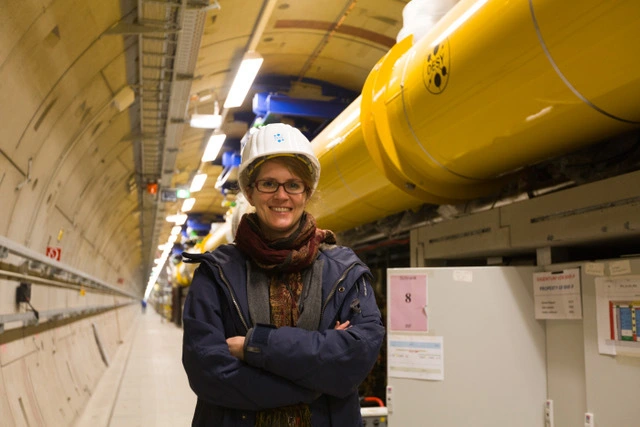
Communicating science in the public eye
Barbara later returned to CERN on secondment from DESY during the early years of LHC operations, a period marked by intense global media attention. The CERN Press Office found itself responding not only to widespread public interest but also to concerns and misconceptions surrounding the LHC, such as conspiracy theories about the creation of black holes. For Barbara, this experience reinforced an important lesson in science communication: rather than dismissing fears, she believes communicators have a responsibility to listen carefully and explain clearly.
“I think it’s important to take people’s concerns seriously. We have to continue to show, every day, that research at CERN is safe, thanks to conscientious scientists and well-crafted science communication.”
The experience strengthened her conviction that effective communication plays a vital role in connecting science and society.
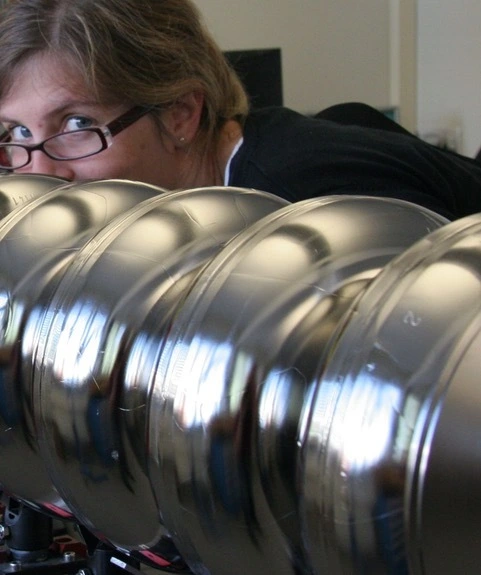
Reaching new audiences
One theme has remained constant throughout Barbara’s career: making science accessible to people who might not actively seek it out, sharing her passion by doing so. Among her favourite projects was an exhibition at DESY that brought artists and scientists together to explore the connections between their disciplines. The initiative attracted visitors who would never normally have set foot in a research laboratory.
“It’s easy to reach out to people who are interested already,” she says. “It’s much harder to attract the attention of the ones who aren’t, but that is also what makes it so stimulating.”
The will to take on that challenge, which also originates from her sense of purpose developed at CERN, continues to inspire her work today.
Writing the next chapter
In 2021, Barbara became a freelance science communicator and writer, allowing her to continue working with scientific organisations while pursuing a long-held ambition since her childhood: writing a book.
Her first book, which was published in November 2025, Die Urknallmaschine, focuses on the science and sociology of the LHC and Germany’s contribution to CERN, highlighting the researchers, institutes and companies involved in one of the world’s most ambitious scientific enterprises.
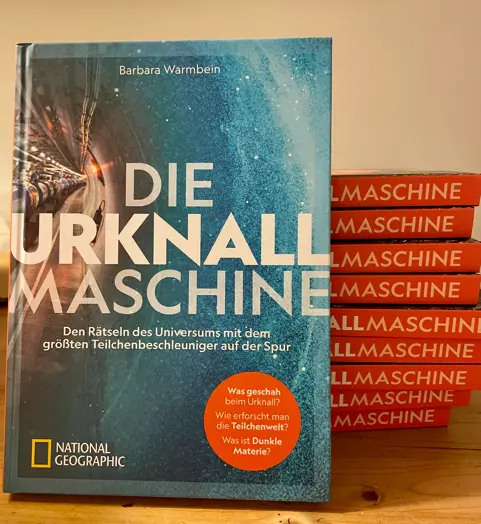
Today, she continues to write about particle physics and other areas of science while developing ideas for future projects, such as new books. She contributes towards the development of material for major laboratories, ranging from articles, infographics, social media to animations. Although communication channels have evolved dramatically over the years, she remains convinced of the enduring value of long-form writing while embracing new technologies and formats.
Remaining part of the CERN community and inspiring the next generation
Barbara remains an active member of the CERN Alumni Network and values the opportunity to stay connected with the Laboratory and its people. For her, the network provides something that extends beyond professional connections. She also particularly enjoys the Office for Alumni Relations-organised events such as the flagship Collisions:
“These events allow people to stay in touch with what’s happening at the place that really changed their lives.”
One area where Barbara is a strong advocate is inspiring the next generation of scientists. Whether it is about the values of science or supporting youth in their professional development, these messages are an integral part of the alumna’s work and personal journey in finding a home in particle physics:
“If you had told me at the beginning of my studies that I would write about particle physics for a living, I would have laughed. But I still wouldn't change a thing, as it has led towards both a great professional and personal journey for me. So, follow your passion: it may take you somewhere you never expected, but often that’s exactly where you’re meant to be.”
Read more about Barbara's work: https://www.warmbein.de/
Share your story
Barbara's story reminds us that careers often begin in unexpected ways. What started as a short internship became a lifelong connection to science, communication and the CERN community. Do you have a CERN story to share? We'd love to hear from you. https://alumni.cern/page/open-calls.