
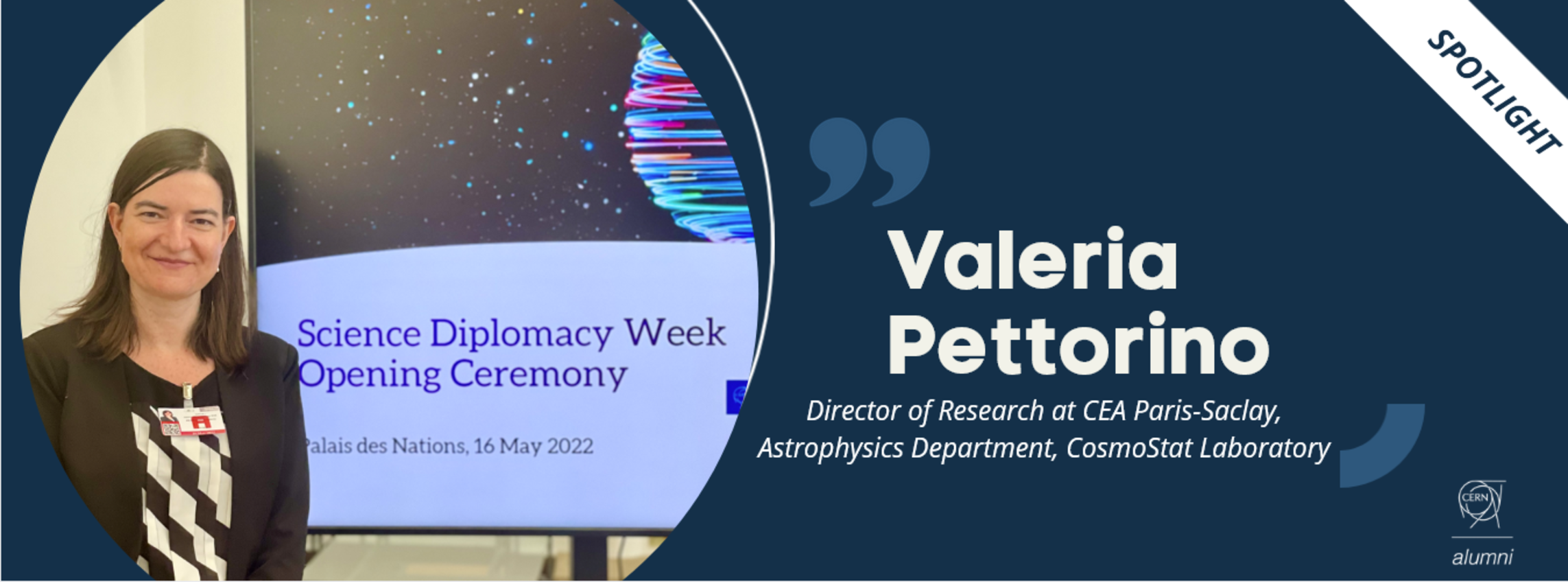
Valeria Pettorino: Making an impact in Space, Cosmos and Mentoring
At CERN: UPAS and VISC – Theory Department
Today: Director of Research at CEA Paris-Saclay, Astrophysics Department, CosmoStat Laboratory
Valeria’s’ fascination with the world of science first began as a young child, in part thanks to her uncle’s influence. During the course of our discussion she recalls how she enjoyed a mixture of subjects when at school: “At that point in time I was not into cosmology, but I liked science, logic and mathematics and being able to combine those subjects with artistic projects, creative writing and travelling. My uncle was also a physicist and would share his passion for science fiction, strings and extra dimensions, which I found inspiring at a young age.” Valeria shares that some of her favourite science fiction authors are Jack Vance and Joseph Farmer.
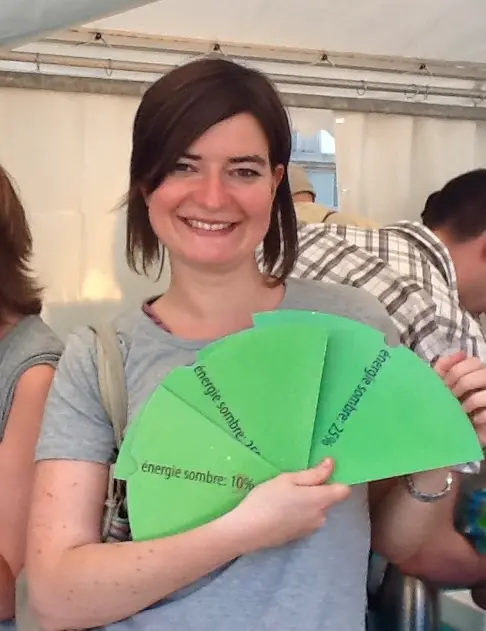 Having completed her bachelor’s degree and PhD in Physics, Valeria’s career journey first started with some travelling around the world, prior to being selected for the Marie Curie fellowship. During her fellowship, Valeria opted to work in Geneva, Switzerland where she benefitted from working with Professor Martin Kunz at the Theory Department, mentor and role model ever since. Valeria recollects how she also had the opportunity to collaborate and connect with people at CERN and was encouraged to go there to participate in weekly seminars and lectures from professionals from all around the globe. This opened up new opportunities for her, as Valeria explains how this enabled her to work with individuals from varying fields: “I collaborated and worked alongside different people from different areas in cosmology and particle physics, leading to a joint paper on astro-particles within the AMS experiment; I got the opportunity to connect with experimental scientists working in different experiments such as ATLAS, the LHC collaboration and also CMS.” Valeria emphasises that working at CERN was an invaluable experience as it also led to her making lifelong connections.
After the Marie Curie fellowship, Valeria then went on to work in Heidelberg, Germany, as a Research Group Leader; during that period she was selected for the “Science to Data Science” programme by Pivigo. This opportunity opened a new door for Valeria as she worked at distance on a healthcare data science project for a start-up company in London. It presented her with the opportunity to widen her skill set, as part of her role entailed utilising artificial intelligence and unsupervised learning to analyse data in the healthcare sector.
Valeria’s career trajectory took a turn towards the space science sector when she began working as a scientist for the Euclid ESA Space Mission in 2007 until present and for the Planck ESA Space Mission from 2009 to 2018. In these research collaborations, Valeria shares how she has been working on numerous projects which she coordinated from start to finish. While leading teams, she has studied management and she has always tried to value everyone’s skill set, with the goal of enabling everyone to reach their full potential, while reaching the team goals efficiently and in a respectful environment.
As in most industries, completing different training programmes and being open to broadening your skillset can help generate new pathways and opportunities in one’s career. Valeria completed training in science diplomacy which helped her gain valuable transferrable skills. Providing further insight on how science diplomacy has aided her in her career, Valeria comments: “I wanted to deepen my understanding on how science can have an impact on the world and society. I decided to be proactive in developing my knowledge and started attending webinars, and then training on science diplomacy. I was selected to participate to the first Science Diplomacy Immersion Programme in Geneva in 2022 organised by the GESDA Foundation (Geneva Science and Diplomacy Anticipator) whose mission aims, in a multilateralist spirit, to take advantage of the ecosystem of International Geneva to anticipate, accelerate and translate emerging scientific themes into concrete actions.”
Developing one’s skillset is important, but so is sharing one’s experience with others. Valeria volunteered to act as a mentor in the Supernova foundation, meant for women in physics around the world. One of the drivers of Valeria’s willingness to share her experience is the recognition that when she embarked on her career, she met very few women in her professional sphere. “I wish I had met more women when I started in this industry and so I am helping to create a network for women so that they can have access to data on career options in this field more easily and make it easier for them to decide what they would like to do career wise.”
Valeria recounts that she first became involved in the Supernova foundation mentoring programme in 2015 thanks to Michelle Lochner, Director of the Programme. Since then, she has actively participated and contributed to this initiative that is dear to her.
“The mentoring programme is open to all career levels. Our mentees range from students, to people, who have not yet done their PhD studies.” Valeria, then goes on to explain the benefits of being part of a mentoring programme such as the Supernova foundation, “one of the many benefits of this mentoring programme, is that there are no barriers. It is a global network of people from 53 countries and there are approximately 300 women in the programme. Networking is very important in any career path and having the opportunity to encounter people from a diverse range of backgrounds allows you to grow your network both personally and professionally. I am convinced, that it is a growing community that will continue to thrive.” Following this path, Valeria has also acted as mentor for Femmes & Science in 2021-2022 (French initiative by Paris-Saclay University); more recently, she was appointed as one of the 100 mentors worldwide of #Space4Women, an initiative of the United Nations Office of Outer Space Affairs (UNOOSA) to support women pursuing studies in space science.
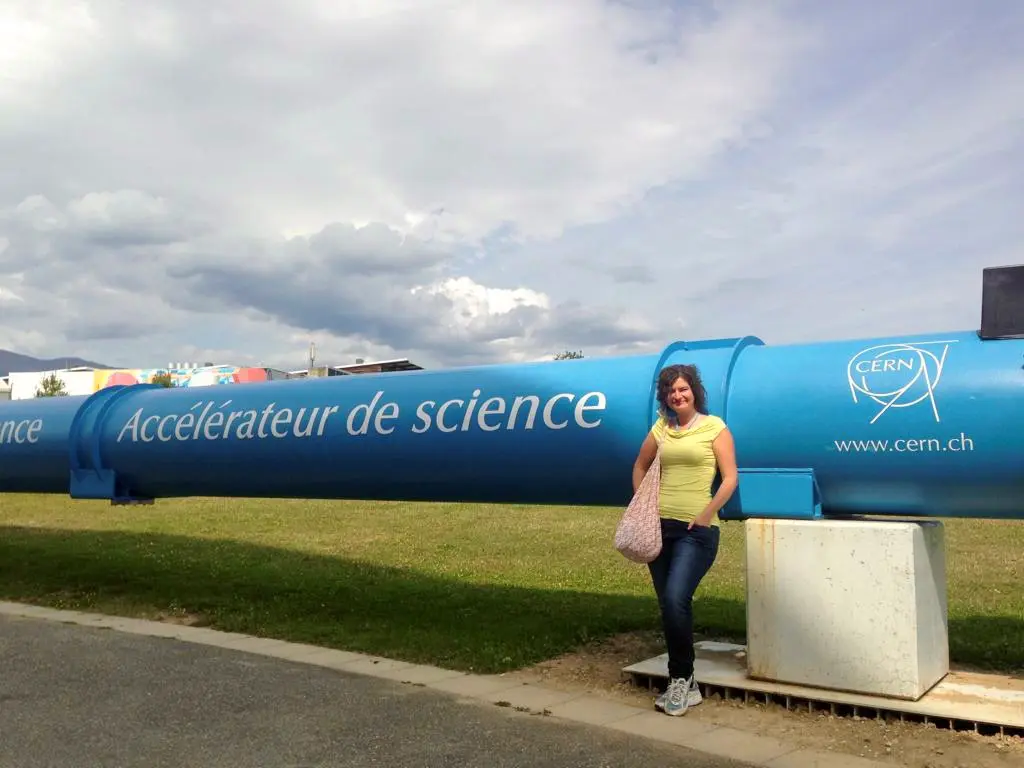 Reflecting back to her time at CERN, Valeria share some of her best memories which included visiting the CMS detector and socialising with colleagues in the Theory Department. Valeria shares more of her highlights, which include, “listening to seminars from invited guests worldwide and having the chance to connect and network with people from different collaborations. Meeting people who worked on particle physics missions always piqued my interest, as they had such interesting stories and experiences to share.”
Member of the CERN Alumni Network, Valeria tells us how she “thoroughly enjoys staying connected with CERN via our virtual events and weekly digest news.” She emphasises the importance of the CERN Alumni programme: “In my opinion, it is a very valuable tool for staying connected with people. Not only is the CERN Alumni Network excellent for CERN as it brings together a wide range of people from many career paths, but it also provides an opportunity for its members to understand and learn how science can be used outside of academia. The CERN Alumni Network is a fantastic platform which gives alumni the chance to hear about exclusive opportunities that they may not know about yet, or have not yet been discovered.”
--------------------------------------------------------------------------------------------------------------------------
Discover how Valeria’s career has flourished in her profile on alumni.cern https://alumni.cern/users/6097112. And if you would like to feature in one of our spotlights or as a panellist, speaker or mentor, please make sure your alumni.cern profile is up to date (professional experience, education, skills and a picture) and contact [email protected]