
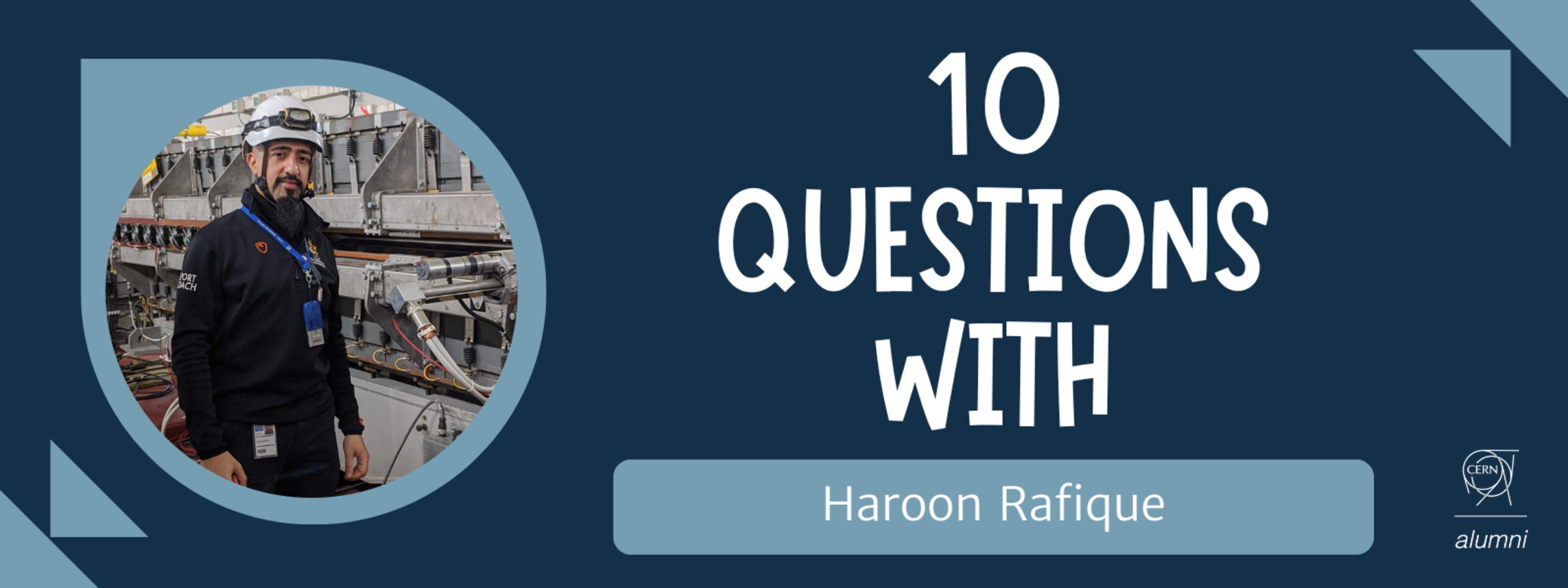
10 Questions with Haroon Rafique
At CERN: UPAS, FELL, VISC
Now: Senior accelerator physicist at the ISIS Neutron and Muon Source
1) When did you work at CERN (including its Scientific Collaborations) and what did you work on?
2011 - 2016 External collaborator on my PhD thesis on HL-LHC collimation
2016 - 2018 External collaborator on FCC-hh machine detector interface
2018 - 2020 Senior Fellow in BE-ABP working on space charge effecst in the PSB and PS
2020 - present Visiting Scientist working on beam dynamics, space charge, simulation codes, experiments etc
2) What is your best memory of working at CERN?
"There are too many to mention. I learnt to play cricket on the CERN wicket near R3, thanks to those in the team for teaching me. I coached the CERN Basketball Club for two years, thanks to the many members who made this rewarding. I've been lucky enough to spend time in the CCC performing experiments on the PS and PSB, thanks to the operational crew and colleagues who supported me.
I recall enjoying the summer student social calendar with many wonderful humans from around the globe. Simply sitting in a restaurant doing work, one is exposed to so many languages and cultures and ways of thinking! The 2019 Open Days were great - we brought the Tactile Collider (teaching particle and accelerator physics to the blind and visually impaired) to point 5 and had a lot of fun."
3) What is your current job and where is it located?
"I'm a senior accelerator physicist at the ISIS Neutron and Muon Source in the UK. The facility is one of many public science facilities operated by STFC (Science and Technology Facilities Council), and is based at the Rutherford Appleton Laboratory (RAL) in Oxfordshire."
4) What skills did you develop during your CERN work experience which have been particularly useful in your subsequent career trajectory?
"Accelerator physics: most privileged to attend multiple CERN (and joint international) Accelerator Schools (CAS).
Team work: it takes an incredible effort of collaboration to operate the accelerator facility at CERN.
Perspective: Having over-focused during my PhD, the subsequent years working with/at CERN gave me invaluable perspective on the design, operation, construction, and funding of accelerator facilities.
Outreach: having guided many tours and explored much of CERN, I have had the opportunity to share the awe of CERN with visitors of all ages."
5) Which skills (if any) did you need to develop further when you left CERN to face your next professional challenges?
"Management, leadership, minute taking, etc. Mostly skills that are pre-requisites to taking on more responsibility."
6) What tips would you give to someone who is considering a career transition from academia to industry?
"I find public research to be more towards academia than industry. From the shared experience of colleagues who have worked in industry (I have not) - there seems to be a larger drive for meeting targets and making profit. These things do not interest me, so I'm happy. Many who are in / have worked in industry have informed me that they miss the freedom of academic research. I would suggest finding someone who has made a similar transition and asking their advice. For example Dr. Androula (Andri) Alekou is a Geneva based coach who worked at CERN and now is an industry leader whose expertise has already been sought at CERN Alumni events based on this topic."
7) What advice would you give your younger self?
"Keep your eyes and ears open, you never know what will be useful in the future. Ask questions if you don't understand something. Network - keep contacts on LinkedIn or otherwise - you never know when you might need to ask someone what it's like to work in their company etc. Try new things, don't stay where it's safe. Branch out and attempt new things. Push yourself out of your comfort zone to grow."
8) Do you still keep a close eye on what’s going on at CERN?
"As a visiting scientist and member of the European Council for Future Accelerators (ECFA) I try to stay aware of the latest developments at CERN."
9) In your opinion, what is the unique value of the CERN Alumni Network?
"CERN is THE temple of science in our time. CERN is evidence of what humanity can acheive when we put aside our differences and work towards a shared goal (in this case discovery). The working environment is unlike anywhere I've ever witnessed. As a result CERN is one of the most accepting and diverse workplaces I've ever seen. Keeping an Alumni network alive is a great deal of work - thanks to Rachel, Simona, and team. The unique value of the network is due to CERN Alumni moving on to cover a vast array of employment - essentially giving all CERN Alumni valuable insight on careers, research, opportunities, etc."
10) Imagine you are stranded on a desert island. You can have one piece of music, one book and one luxury item. Which music, book and luxury item would you choose and why?
"Probably something like the Buena Vista Social Club album, or a long classical peice such as Elgars Nimrod from the Enigma Variations. The book would be a desert island survival guide, or perhaps some fiction such as Patrick O'Brians Aubry Maturin series. The luxury item would likely be a razor so I can keep my head nice and shiny!"