
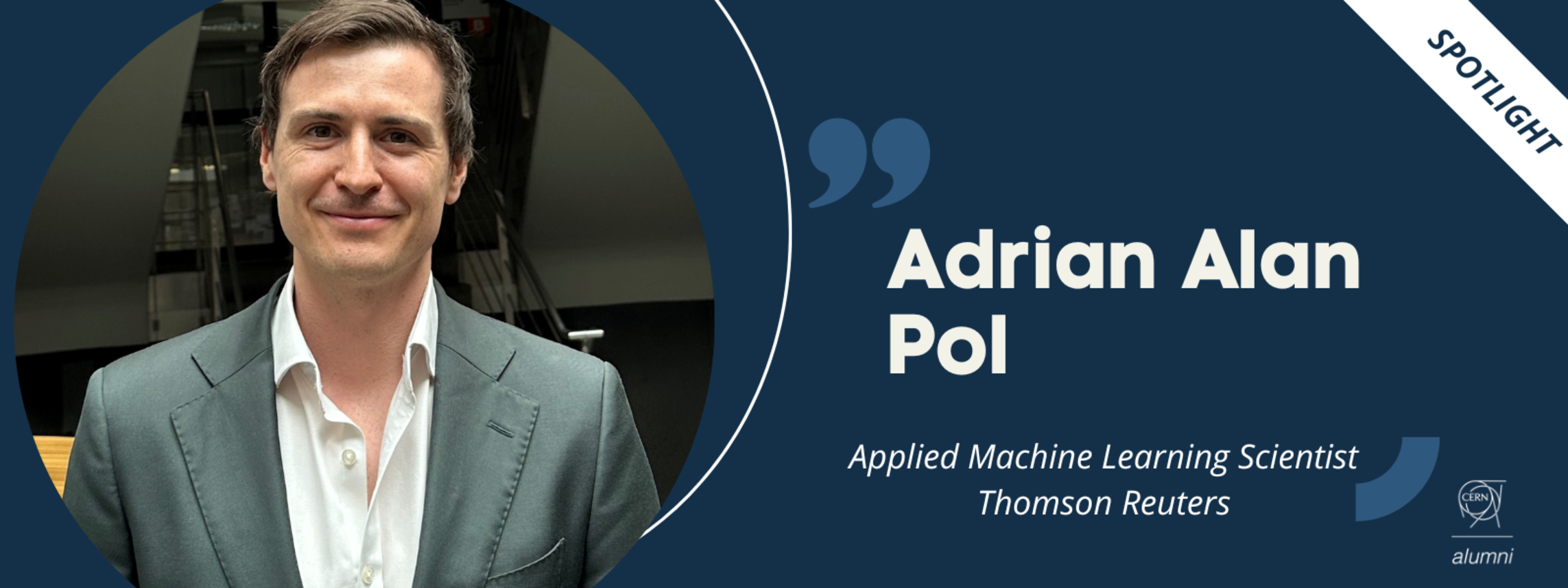
Machine Learning and Serendipity: Adrian Alan Pol’s career evolution from CERN
At CERN: Summer Student (2013), Technical Student (2014-2015), Doctoral Student (2016 - 2019), Fellow (2020-2022), User ( 2022- 2023)
Now: Applied Machine Learning Scientist, Thomson Reuters
Discovering CERN
The discovery of the Higgs boson in 2012 wasn't just a monumental achievement in particle physics; it also served as a beacon that drew many bright minds to CERN. One of them belonged to CERN alumnus Adrian Alan Pol, whose journey from a curious master's student in Copenhagen to a successful professional at Thomson Reuters is evidence of the transformative power of the CERN experience.
Adrian's path to CERN began in a rather serendipitous manner. While pursuing his master's degree a CERN alumnus came to his university to present career opportunities at CERN, which planted the seeds of curiosity. "It was a five-minute announcement before a lecture," Adrian recalls. "Additionally, CERN was all over the media because of the Higgs boson discovery.”
This brief encounter led him to apply for a summer internship, and soon he found himself immersed in the world of cutting-edge research at CERN.
Rising Through the Ranks at CERN
His first assignment was with the ALICE DAQ, where as a summer student he developed Python scripts to automate monitoring pipelines, an experience that shaped his technical skills and introduced him to the collaborative spirit of CERN.
“I would definitely recommend coming for eight or 12 weeks to do the summer programme, especially for the exposure to cutting-edge technologies. Unlike some companies where interns might not always be given significant responsibilities, CERN offers a unique environment that balances learning with impactful work. While there is not excessive pressure since you are still a student, the opportunity to contribute meaningfully is very much present. If you perform well and show commitment, your efforts will be greatly appreciated, and your input will be valued in meetings.”
This initial success paved the way for subsequent roles, including a technical student position at CMS and eventually a PhD, where he explored the field of machine learning—a move that proved to be prescient as the field subsequently exploded in popularity and application.
Adrian's time at CERN was marked by numerous professional highlights. One particularly proud moment came when he saw the web service he developed for monitoring Monte Carlo simulations being widely used within the CMS collaboration. "I thought maybe 10 people would use it, and then I started seeing screenshots of my web app in weekly meetings. It was so cool," he beams.
Transitioning to Industry: Challenges and Triumphs
“CERN was home for 10 years. It was a place of immense growth, both personally and professionally," Adrian reminisces. During his time at CERN, Adrian built lasting friendships and professional relationships that still endure today. "Recently, I attended a wedding, and half of the invitees were from CERN. It's a testament to the strong bonds we form here."
However, Adrian's journey was not confined to the walls of CERN. Four years in a postdoctoral role (CERN Fellowship and at Princeton University) culminated with a critical decision point—whether to stay in academia or transition into industry.
"I was committed to moving to industry to advance my career," Adrian explains. "But I recognised the trade-offs. Academia offers more independence; you can drive projects based on your interests more easily. In the private sector, it's a more organisation-oriented process. You cannot just pursue what interests you on a whim, but in academia, if you secure grants, you can conduct your research."
The transition was challenging, especially with the tough job market in late 2022s when many companies imposed hiring freezes. Despite this, Adrian's persistence paid off, partly thanks to the support and resources from the CERN Alumni Network. "The Moving Out of Academia events where attendees are coached by CERN alumni from the industry on how to prepare your CV for the private sector were very useful," he notes.
“I participated in the Knowledge Transfer collaboration with Ceva, a leader in digital signal processor technology. Exposure to the practices used in the private sector was also beneficial.”
Through a combination of networking and continuous learning, Adrian landed a role at Thomson Reuters. A chance encounter at a boot camp introduced him to the opportunity. "I took part in a boot camp where a former Thomson Reuters employee gave a talk about their graduate program. I applied, got an interview, and here I am," he recounts.
New Beginnings at Thomson Reuters
Adrian’s role as a machine learning scientist at Thomson Reuters involves a mixture of familiar and new challenges. "At CERN I was training models, and now I’m focusing more on data engineering instead," he explains.
Despite the differences, Adrian finds the work equally stimulating. "I think I’m training skills that I never used in my life. From a career point of view, I do not miss CERN. I feel like I was strong enough in certain aspects, like the research skills, and now I’m exercising the corporate skills, which are different."
Reflections and Advice for Future Alumni
For current and future CERN alumni, Adrian's journey underscores the value of being adaptable and proactive. Whether it's developing a new skill, seeking out mentorship, or leveraging the alumni network, the tools and support systems are there.
“I found out that at Thompson Reuters we receive many CVs from CERN. Often, they are very academia oriented and this is not what industry is looking for. In the events like the ones organised by the CERN Alumni Network, you are coached by people from industry on how to present your achievements to the private sector, which is very useful.
If you are committed to transitioning to industry, the best time to start is always a year ago. But the second-best time is today. Don't delay your applications for a couple of months because you might miss interesting opportunities. Often, you will face rejections at different stages of the interview process. Treat these as lessons, analyse what went wrong, and learn from them.
You need to develop this "interviewing muscle", as it’s different from what you typically do every day.”
He also emphasises taking advice with a pinch of salt, as people's experiences vary. What works for one person might not work for everyone, such as whether to include hobbies on your CV or how long it should be.
As Adrian continues to thrive at Thomson Reuters, his journey serves as an inspiring example for fellow CERN alumni. It shows the power of the CERN community and the opportunities that lie beyond its gates, showcasing how skills honed at CERN can lead to success in diverse fields: "There is life outside of CERN, it’s very different, but it’s still very exciting."
Adrian recently participated in the CERN Innovation Partnership's webinar: “AI and Computing Challenges: Harnessing Large Language Models at Thomson Reuters”,
Watch the seminar to discover how LLMs are reshaping industries, and gain more valuable insights from Adrian’s experience. https://videos.cern.ch/record/2300275