
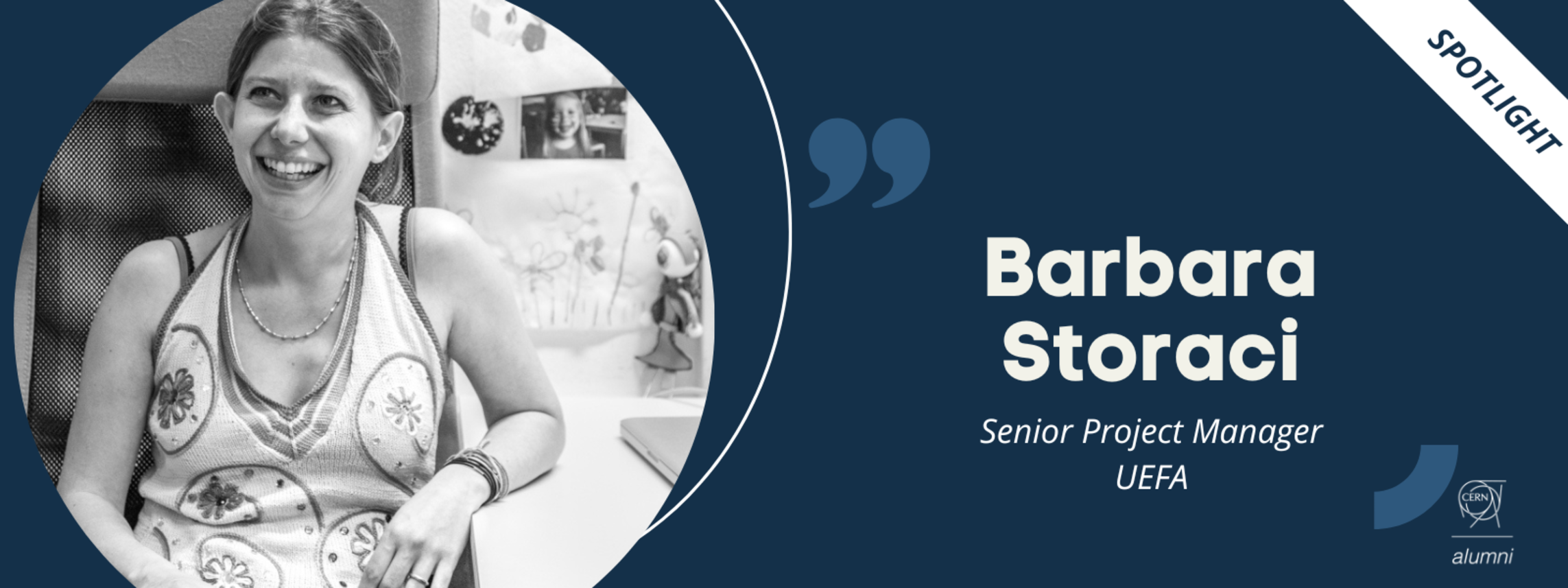
Barbara Storaci – Thrown in at the Deep End
At CERN: 2006 – 2017 User & Technical Student in LHCb,
Today: Senior Project Manager UEFA
Fascinated by protons, neutrons and quarks
Barbara was one year into her Masters’ degree in physics at the Università degli Studi di Milano-Bicocca when her university professor suggested she spend a couple of months over summer working with the LHCb collaboration, which, at the time was in the building phase. She explains,
‘I was given two weeks’ notice to take up my first position with the LHCb collaboration. My specific responsibility was setting up the insulation for the magnetic shields of the HPD (Hybrid Photon Detectors), part of the LHCb RICH detectors. This involved putting on the kapton insulation sheet, cleaning and testing them. I had to be scrupulously precise, if not; I would have to go through the whole procedure again. I was really thrown in at the deep end; my colleagues gave me a brief explanation of what I had to do and then left me to my own devices! Another moment when I did feel out of my depth was the first time I experienced a summer storm, accompanied by the typical power cuts. At one point, to my absolute horror, I lost my testing system. This really panicked me, but I managed to get it back up and running!’
Ever since she was a little girl, Barbara had dreamt of working at CERN, the mecca for particle physicists. She admits, from a very early age, she built on her knowledge to achieve that very goal. At the age of 11 she was inspired by her science teacher to dig even deeper,
‘During one lesson, our teacher explained protons and neutrons and I found her explanation simply fascinating. My curiosity had been sparked and I was thirsty for more, so I read all I could about these particles. To my surprise I discovered that there were also quarks, when I quizzed my teacher about them, she explained that it was beyond her level of knowledge, but I continued being curious to comprehend even more. It was ultimately thanks to this teacher that I became a physicist.’
A rich overview of an almost full detector lifecycle
Following Barbara’s first successful summer experience at CERN, her university professor proposed a technical studentship, which Barbara readily accepted. Such a strong passion for physics meant that Barbara not only invested her time in working on the hardware aspect linked to her Master thesis in the LHCb, RICH 2 group, but she also worked on analysis as well as squeezing in revision for her exams. Throughout this hectic schedule, Barbara was implicated in a multitude of tasks ranging from the commissioning of the detector, the final phases of testing, cabling and taking data. Prior to the end of her time at CERN, she joined the SHIP experiment and saw first-hand how a detector is designed, giving her an overview of the full lifecycle!
‘For someone of my generation, it’s quite rare to have such a wide-ranging overview of these experiments, and this fits my character as I need variety and stimulation. Moreover, it helped me develop a broad portfolio of skills; developing both hardware and software, writing track reconstruction algorithms, data acquisition as well as taking on the role of operations coordinator for the LHCb experiment. Having such a managerial role made me confident that I would be able to survive outside the field of research, and I am extremely grateful that the spokesperson was crazy enough to appoint someone as young as me to the position.’
Once again, Barbara found herself thrown in at the deep-end to fulfil this role.
‘This is my style; I thrive in such challenging situations and find it highly motivating. Of course I learnt by making some mistakes, but I also tried to analyse people’s behaviour and understand the knock-on effects and consequences. This enabled me to identify areas in which I could improve, and learn good habits from my colleagues. I think I was given this role thanks to my broad overview of different areas of the experiment but it was initially quite intimidating as those I coordinated were all much more senior and had a more in-depth knowledge of their specific sectors. I wanted to foster good communications amongst my colleagues, so prepared our meetings scrupulously, identifying the key points to address. I also invested a lot of effort in preparing clear and detailed minutes, giving context and layered information so as to meet different needs depending on the reader’s level of expertise. This was very demanding, we went through various small crises and were very much under pressure, I frequently had to meet with the spokesperson, provide input and convince them to take specific actions. It was an amazing experience and I consider myself extremely fortunate to have been given this opportunity.’
Reaching a career crossroads
With such fulfilment professionally and having achieved her childhood dream to work at CERN, Barbara could have settled for a fruitful career in research; however the doubts started to creep in. Firstly, having had two daughters, in the first and last year of her PhD, stability became an increasingly important factor in deciding which direction to take in her career. Additionally, she began to feel a certain pressure to write projects that would look good for committees, but not necessarily research,
‘My husband and I, who both come from Italy, wanted some stability for our kids. In terms of my work, I had the feeling that whilst my role as operations coordinator was great for my development, it was not so good for my CV, I was in direct competition with my peers who were conducting data analysis, I, on the other hand had a role more similar to senior management. I decided to move back to analysis but had the impression I was no longer fulfilling my passion, but rather more perfunctorily fitting in with what others wanted of me. I realised that I loved the role of operations coordinator and this was the trigger, telling me I could indeed be happy outside of academia, but It took a few years before I accepted that realisation.’
For Barbara, it became clearer that it was possible to find professional fulfilment outside of academia; however, certain nagging thoughts persisted.
‘I did harbour some doubts about my future direction. For instance, was I renouncing on my dream to work in research? Could I fulfil more than one professional dream and was it possible to live many different lives? I was lucky in so far as I was able to take my time looking for the right job for me, I was not out of work, so felt no pressure but rather enjoyed the luxury of being highly selective. My starting point was to understand my different passions. Of course, I had already identified physics as one. Sport is another. I find that practising sport relieves work-related stress. Whilst at CERN a friend persuaded me to join her at her taekwondo class. It was an amazing discovery which helped take my mind completely off work, unlike running for instance. Basically, if you risk being kicked in the head, you will concentrate fully on not being kicked in the head! I’ve been an instructor for several years now and I set- up the Taekwondo section of the CERN Martial Arts Club that now still runs successfully under the guide of David Barney. It is extremely gratifying to see our members’ enthusiasm for the activity. Another advantage of taekwondo is one can compete at any age. Not only that, but standing in front of a group of judges is both a mental and physical challenge which also prepares you well for any presentations you might have to make as a physicist. One other dream I had as a child was to play football in a team, but as a girl in Italy in the ‘80ies I was not allowed. In fact, I would have to wait until my current job to do so!’
Sticking to Plan A
Barbara commenced looking for opportunities in organisations that resonated with her. She carefully tailored her CV to fit specific jobs and requirements and one day came across a position advertised with UEFA.
‘My initial reaction was that it looked rather strange. From the job description, I inferred that they were looking for a physicist. The job title was ‘Project Specialist’ and the job description listed requirements such as; project management, coding experience, analytical skills, coordinating members of a team. I applied immediately and was invited for a Skype interview. This was so much better than the online interview platform experience I had at CERN, here at least I had contact with a human! This was followed up with a face-to-face interview. Usually interviews are not renowned for being pleasant experiences, but in my case I thoroughly enjoyed it!’
Barbara took up her position with UEFA in February 2018 and quickly assimilated her new functions. Variety and stimulation continue to be the order of the day; she leads many different projects and liaises with the other groups within UEFA,
‘For instance, we have specific tasks such as writing script and code to improve the efficiency of other colleagues’ every day jobs. I also work with the legal team, the stadium and accommodation experts, on issues related to the pitches and the broader details behind football matches. We are also responsible for draws, bidding, regulations and manuals and coordinating those areas.’
Fortunately, Barbara is a football fan and since integrating UEFA, she had joined the UEFA football team! However, her enthusiasm for working at this Organisation goes well beyond just football thanks to the multifaceted aspects of her job,
‘Seeing the pleasure on a colleague’s face for whom I have developed some code that will save them hours of work is highly satisfying. Working in this environment is hugely enriching as the employees are from diverse fields of expertise. Consequently, people think differently and one is obliged to change the way of communicating. At CERN, the culture is generally scientific but at UEFA, this is not the case and people approach tasks differently. I would say we work in a very complimentary way. Whilst my work at CERN was intellectually challenging, my work here offers different types of challenges. Our deliverables form part of a bigger picture, we have strict delivery dates, and we have to respect legal and regulatory aspects. There are some parallels, for instance, the amount of data to exploit. I think data analysis in football will definitely play a huge role in the future. I certainly can see similarities between the two worlds.’
Sage Advice and a green CV
I asked Barbara to cast her mind back to the point at which she decided that she would seek a new challenge out of academia, as I wanted to understand what advice she would give people in a similar position today.
‘I wrestled with my own fears of seeing myself and being seen by others as a failure if I left the field of academia. Doing a postdoc at CERN is a clear indication that you want to be in research. After much agonising, I came to the realisation that I had succeeded in my career at CERN, I had other passions than just physics and that I was keen to take on another challenge elsewhere. My conclusion was, it is possible to be professionally fulfilled outside of academia.
My next piece of advice is to think carefully about what you want to do and put all your efforts in accomplishing your plan A, do not compromise and move to your plan B too quickly. Next, tailor your CV to the specific job you are applying for and accept that nobody will really care of the details of your analysis outside the research field (so don’t put them!), but to get to it you had for sure developed and used important skills that are useful also in the real world. Highlight them, avoid too much physics jargon and show why even coming from such a different world still will be an asset for that company. If you reach the interview stage, show that you are passionate about that job. Highlight your strong analytical skills and any coordinating or management role you might have held. Convey this information in your CV and your interview, especially if you coordinated teams where you were not actually the line manager. This demonstrates your ability to lead and convince people to work together.
Something I found extremely useful was to meet a friend who is not from the scientific field and ask her to look at my CV and ask me some typical interview questions. I was completely ill-prepared for some of the HR types of questions she asked, such as ‘tell us about a boss you worked for that you did not like”, this was a game changer for me! Finally, despite my friend’s advice I submitted a green CV, not only because it stands out, but also because it was an expression of my personality. I figured, if my future boss does not like my green CV, my future boss will not appreciate me! I took that risk and it paid off. My boss joked for many years about my green CV though!”
7 years of fun
Since that day in which she has submitted her green CV for applying for a “project specialist” role Barbara has done a nice career inside UEFA becoming first a manager and few years ago a senior manager. Now her scope and projects have drastically increased arriving to fully coordinating all draws, including doing for the first time in the history of football a digital draw.
“My entire careeer even here at UEFA has been full of surprises as the day I have been appointed to look into the draws. When I have started I didn’t know a lot, and now I am quite an expert. I am working with many internal colleagues learning so many things, from how to make a draw procedure, to how to setup a meaningful stage, but also with external providers. Working with them to ensure they could develop a digital draw that is fully random and correct is an amazing experience, where all the technical and even more analysis skills have been so useful. Here to ensure that everything is done correctly there is a lot of statical analysis and checks we had designed.”
While when she joined she was a rarety at UEFA, now many more colleagues are coming from CERN or from a scientific background.
“I think UEFA and many industry sees or will see the advantage of profile like a physicists who has spent many years in the research field. The world is more and more data driven, and the analytical skills, together with coordination capability, integrity and the ability to never been scared by a huge unknown topic or problem, but even been excited by it, are so precious everywhere. I am so happy now to have other colleagues coming from CERN helping me in my daily job and with whom I can challenge and discuss new ideas and approaches.”
Why live only one life when you can live many?
Barbara has not only changed her career but she has now time to stay with her family and follow her passions and hobbies.
“Especially at the beginning, but from time to time also today, people asks me if I regret my choice. If I could go back I would study particle physics again, and I would do the 12 years of research at CERN, but I would also change career at a certain point: I definitely not regret my choice. When you become a physicist you will remain it for the rest of your life, but now I am so happy, I have new challenges, and I am learning things that by staying in the research field I would have probably not learnt. I have a much better work-life balance: I work hard, but there is a culture of respect of your private life, your need to do sport, and I appreciate it a lot. I have time for my family, for doing a lot of sport and other hobbies, and even be a volunteer firefighter and help the community around me in my village. It has been great to follow my childhood dream, but now I can follow many dreams, I can live more than one single life, and this makes me happy and accomplish in a way that probably physics alone would have not.”
Barbara became a member of the CERN Alumni Network prior to leaving CERN and also attended several editions of the annual LHC Collaboration Career Networking. In November 2019 she was also a panellist at this event. Barbara explains how helpful she found these events and how much they have improved.
“The CERN Alumni Network is a great programme, as are the events you organise. At the first few career networking events, we saw speakers who had moved into the traditional sectors, such as finance and consultancy, but in the more recent editions we have seen a much greater diversity in trajectories and this is so positive. Personally, I want to be able to fix things and improve them, which is very easy in science, I was scared not to find this outside and to feel constrained, but I succeeded in finding a job where I can do just that! Thanks to the CERN Alumni Network, other members demonstrate that one can be fulfilled outside of academia. As for me, I am very satisfied with my current situation, but who knows in ten or fifteen years, maybe I will have another passion to follow!”
We are looking forward to hearing how your career flourishes Barbara!
Author: Rachel Bray, CERN