
Bridging disciplines through storytelling: Annemarie Mattmann’s journey from CERN to Science Communication
Bridging disciplines through storytelling: Annemarie Mattmann’s journey from CERN to Science Communication
Annemarie Mattmann’s CERN story began long before she walked through the Organization’s doors as a technical student. Still in school, she attended a series of Saturday morning physics lectures at her local university in Mainz. “In one of them, we talked about CERN... I don’t remember the topic exactly, but it was probably something related to the search for the Higgs boson,” she recalls. That day ended with the suggestion of a group visit to CERN—and enough of the room raised their hands. Annemarie took part in that trip. “I was still in school at the time, and I actually met my now husband on that very trip.”
Before and at CERN
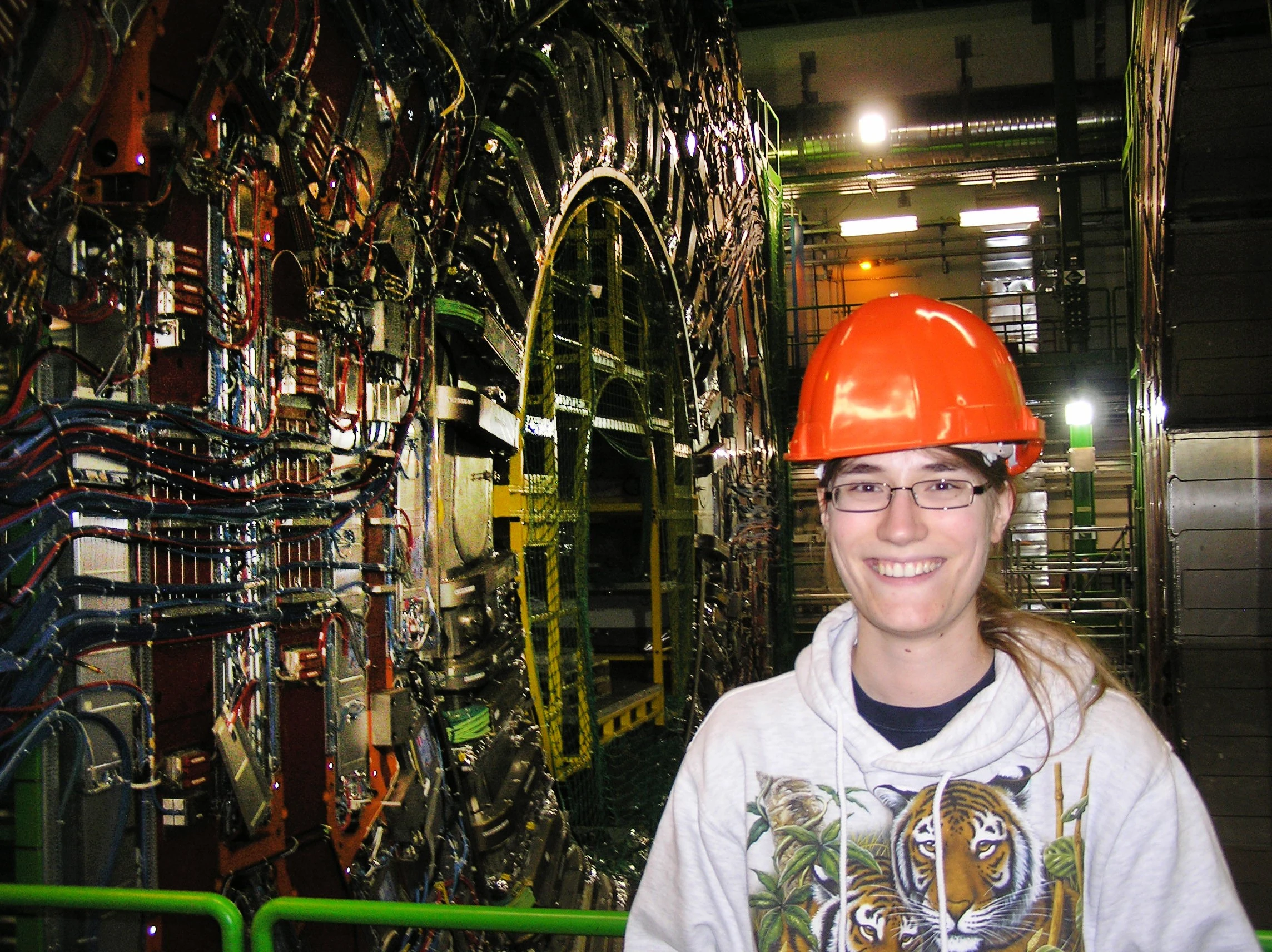
This early connection set the tone for what would become a multi-layered relationship with CERN. Annemarie would return several times, initially to visit her brother who was doing his PhD at CERN and then her partner during his summer student experience. Eventually, she joined CERN herself as a technical student, working on a project that sat at the intersection of computing, documentation, and long-term knowledge preservation. “The project was based in the library, but it was also closely related to the IT, the CERN Open Data Portal and our direct neighbors from INSPIRE.” The INSPIRE project serves as a one-stop information platform for the HEP community, comprising eight interlinked databases on literature, conferences, institutions, journals, researchers, experiments, jobs and data.
The aim was to ensure the reproducibility of research analyses after physicists left the organization. “So many physicists come to CERN, they do their analysis, and then they are gone, and all the work they did is at best kept in notes, which are not always simple to decipher.” Her role involved talking to physicists to understand their analyses and figuring out how to represent them meaningfully on a centralised platform. “I ended up doing a lot of communication work… asking questions until I grasped what they were talking about.” From there, she translated those conversations into GitHub issues for her development team.
CERN takeaways
Beyond the technical, Annemarie found her experience at CERN deeply formative on a human level. “This was really the first experience where I got to talk to people from different disciplines, different ages, basically different backgrounds.” That diversity became one of her most cherished takeaways. “Communicating with your own people in your own country can already be hard because everyone’s a different character. At CERN you have a lot of layers, but everyone tries to communicate.” In that environment, openness and curiosity were fostered in a uniquely positive way. “Everyone was kind of a stranger and kind of interested in everyone else. It was a feeling I never got after that.”
After CERN
After CERN, she returned to Germany to finish her master’s in computer science and went on to begin a PhD in IT security in the same group where she had completed her thesis—though it was not her first choice. “I thought that what I would really love to do would be to publish my books because I was writing fantasy.” Her professor, understanding her passion, offered part-time work so she could pursue writing alongside research.
The PhD extended over four years, culminating not in a thesis but in an evolutionary shift toward her passion: storytelling. A turning point came when she asked her professor, “Can I just try this out on your project?” He agreed, and she began working for emergenCITY, a major initiative on resilience and emergency communication. “It’s a topic where you can use storytelling really well.” This evolved into freelance work in science communication, where she now runs her own one-woman company. “I’m starting on my own right now… I'm freelancing as a storyteller.”
Her work today
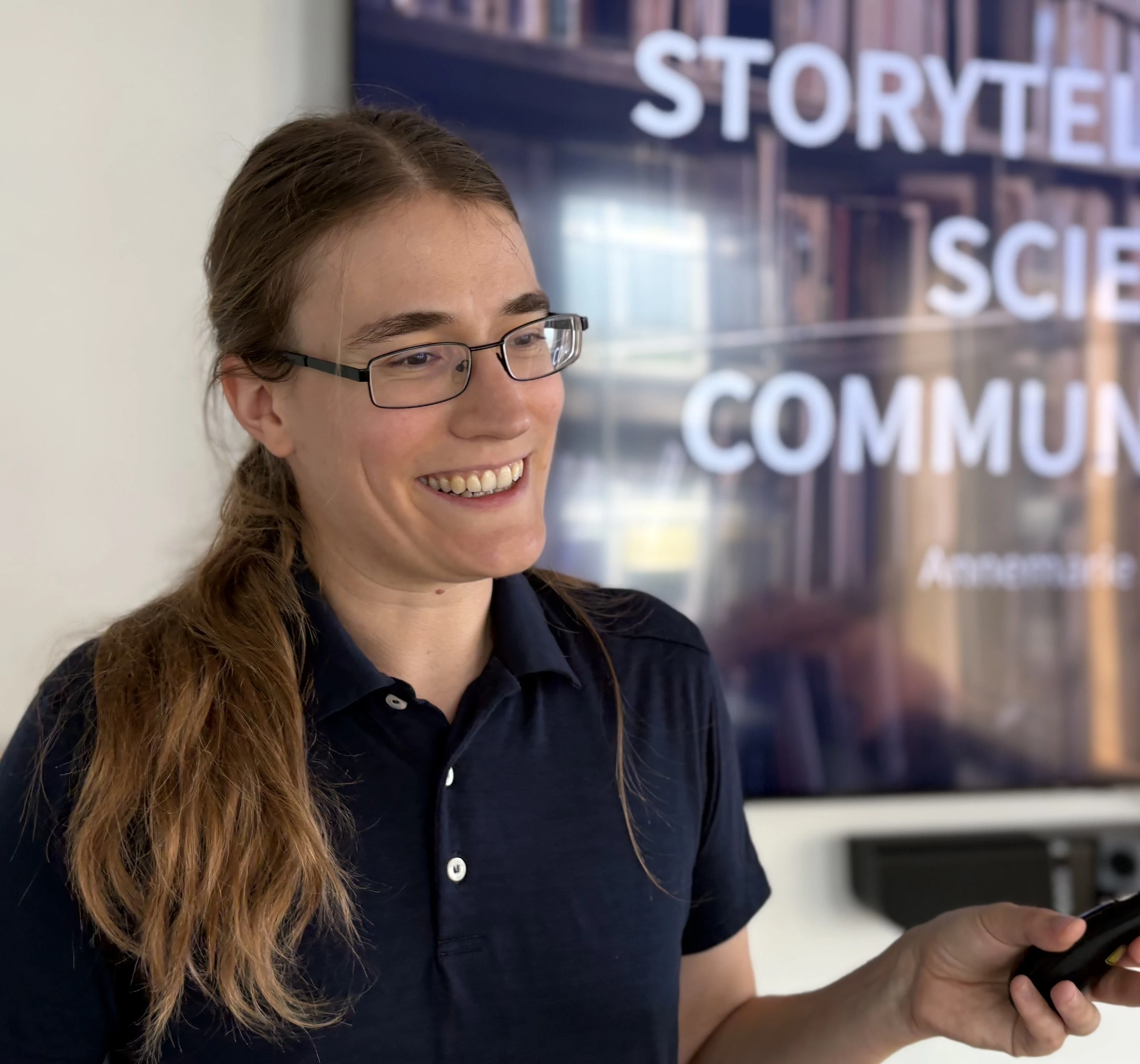
Today, her work takes two forms: workshops and writing. Her storytelling workshops aim to help scientists communicate clearly and meaningfully. “The big idea would be that there are no boring talks in science anymore,” she says. “I had this wish that people would communicate better, more engagingly, more clearly.” She prefers running these sessions in person, where spontaneous discussions can flourish. “People ask you questions which are a bit unexpected but sometimes become really important.”
On the writing side, she crafts stories that make scientific projects and concepts come alive. One project she’s especially excited about is a video game, eHUB cities – Blackout, currently in development for which she’s collaborating with an indie game studio and other creators. It was commissioned and directed by emergenCITY to show how their research can help people navigate crises. In it, players live in a self-sustaining house during a power crisis and must make strategic energy decisions — but also face the choice of helping their neighbors or prioritizing their own goals. “There’s a story for each in-game character because the goal is for it to feel like you're really living in that home. To experience how the crisis influences your daily life and the decisions you can make.” Annemarie's role is to craft an immersive, nonlinear story rich in social, personal, and resource-based conflicts through the game’s dialogues. She also provides entries explaining the scientific background information that players can read when they uncover their in-game representations.
 In a very different but equally meaningful project, she is co-authoring a blog with a professor about innovative university lectures, including one that takes the form of a nonlinear, interactive story. In this lecture, students choose their own path through the narrative, encountering cybersecurity challenges along the way that they must solve using the concepts covered in the course. She explains that the goal isn’t to claim this method is the best, but rather to show what this kind of lecture actually looks like in practice — with both its strengths and its challenges — and to highlight that there are alternative ways of teaching beyond the traditional lecture format.
Across her projects, the principle of honesty in storytelling remains essential. “Storytelling is worth nothing if you tell a lie,” she stresses. Whether explaining technical data or crafting fictional tales, she strives to stay true to the core. “Whenever you're actually sticking to the truth and working on your story to tell truth, then it gets a little more complex— but it also gets better. There’s beauty in truth, even if it’s messy.”
Though she hasn’t published her fantasy books yet—“I figured I like writing a lot more than advertising my writing”—writing remains central to her identity. Whether building games, supporting crisis resilience communication, or helping scientists find clarity and confidence in their work, Annemarie sees storytelling as a powerful, connective tool.
CERN Alumni Network
Reflecting on her time at CERN, Annemarie describes the experience as a unique “n-way connection,” where everyone came from different backgrounds but shared a mutual curiosity and drive to communicate. While many of the people she worked with have since moved on, Annemarie sees the CERN Alumni Network as a way to keep those connections alive. “Keeping in touch is a bit hard,” she admits, "but the network offers an opportunity to rekindle that collaborative spirit."
Annemarie attended the Third Collisions 2024 event and appreciated the chance to reconnect with CERN. "It was really nice, because I hadn’t been back in a long time, but you immediately connect with other alumni” she shared. For her, events such as Collisions offer a moment to revisit the unique environment CERN creates—where people from different disciplines, backgrounds, and countries find ways to understand each other and work together.