
We gave you the floor; here is what you told us!
On 15 July 2020, 4336 alumni received a request to contribute to the 2020 Global CERN Alumni Survey. 20% of you responded which provided highly valuable data to help us steer the High-Energy network in a direction that really serves our members.
As promised, we are getting back to you today to share the results with you, and how we intend to leverage on the survey to grow and strengthen the network.
An independent and professional survey with a double purpose
Survey is the buzzword today and you have surely experienced this. Companies, organizations and communities are constantly soliciting your attention for feedback and requests to respond to their questions. You may be suffering from survey fatigue. So we are all the more grateful that you took the time to contribute.
Firstly, our intention was to answer the question, with your help, what is the Unique Value Proposition of the CERN Alumni Network? What is it that makes it different from all the networks or communities you already belong to? Also, what are its Unique Selling points? In other words, what problems can we solve for you?
Secondly, we wanted to understand, after three years of existence, what you like about the network and what we are not succeeding in doing for you.
To maximize the chances of understanding this and maximizing the outputs of the survey, we decided to entrust it to a professional and independent consultant. We were also very much aware of the risk of inherent bias, had we conducted the survey ourselves.
Following a competitive process, we selected the company Deep Blue Thinking (UK) , https://www.deepbluethinking.co.uk/, and collaborated with its CEO, Nick Bonney, on all phases of the survey. From design to data collection, analysis and reporting. In addition to the quantitative data analysis of survey responses, Nick Bonney conducted six in depth interviews via video conferencing with selected alumni. For each of these interviews, we should like to highlight that a 100 CHF donation was made on their behalf to CERN & Society.
Our collaboration with Deep Blue Thinking has been extremely successful and we obtained the results of the survey early October.
What is unique about this network? What is tying this community together?
This is a key finding of the survey and one that we were most interested in.
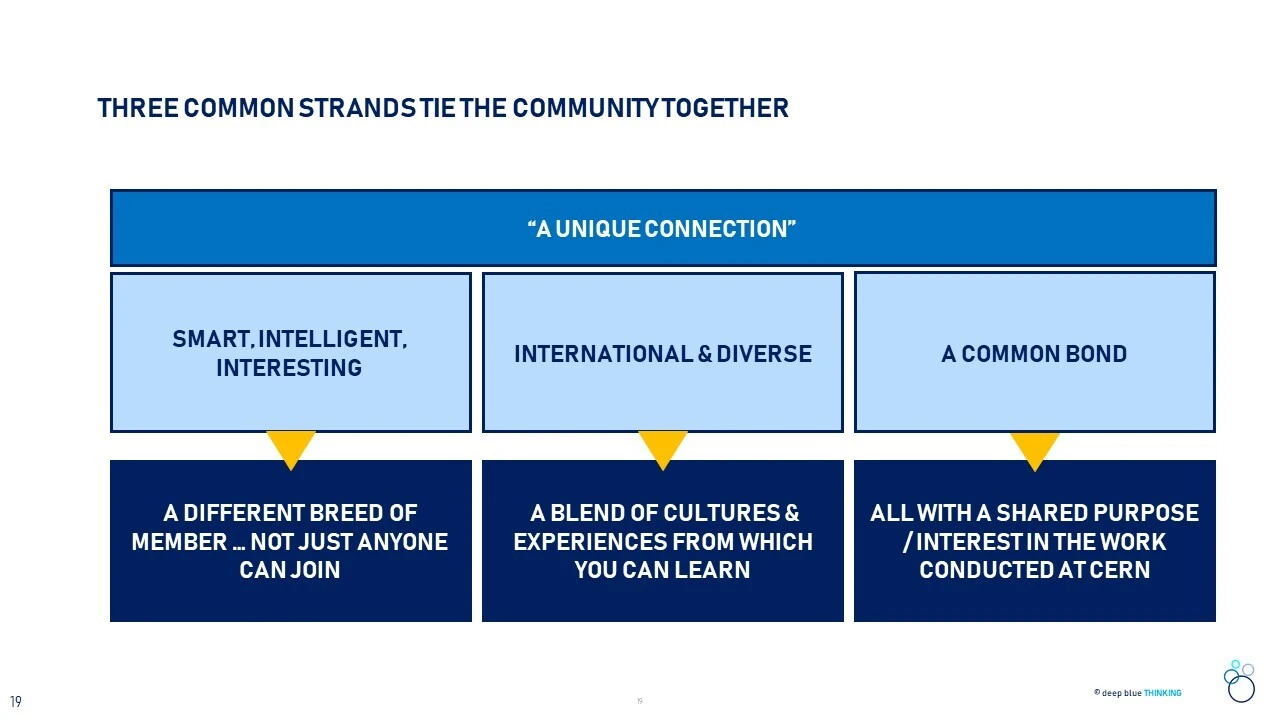
This led us to confirm what this network brings to you that no other network can offer, which is that it enables you to:
Stay connected with a unique endeavour and like-minded people:
- Unique by its mission of peaceful scientific collaboration for research and education
- A diverse, multicultural, worldwide community of unique professional backgrounds and high brain power
- A supportive and approachable community
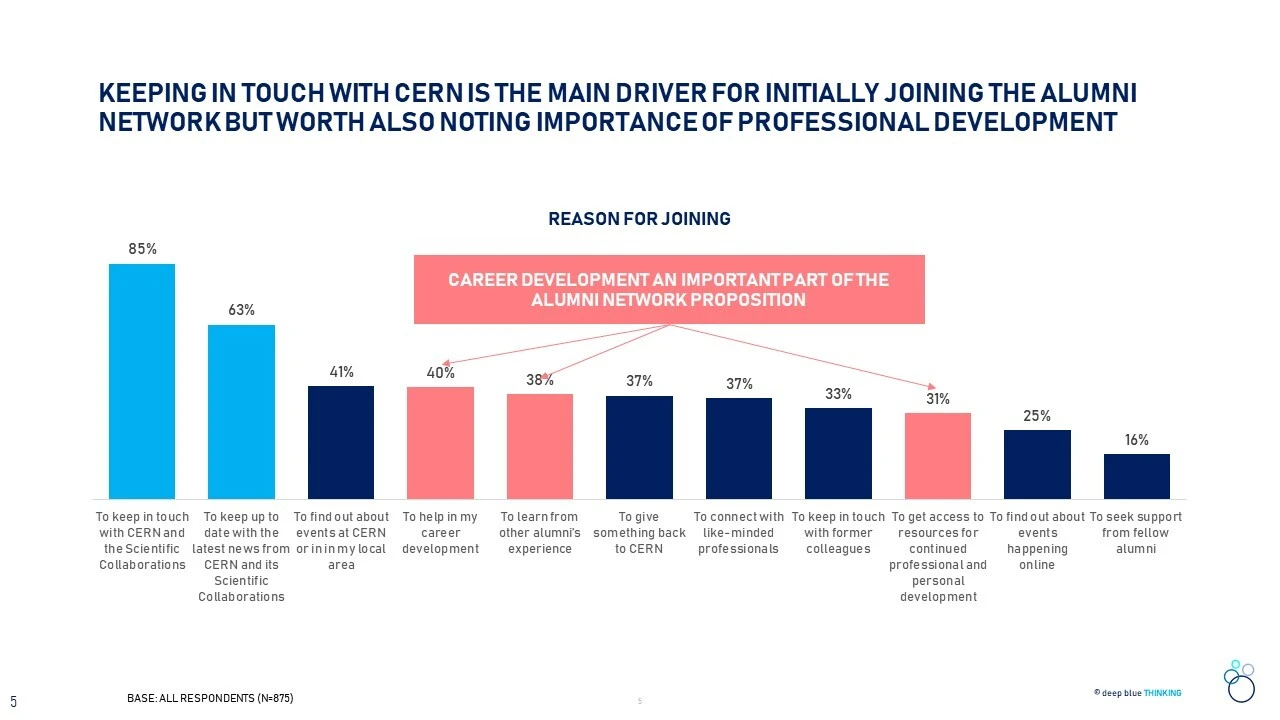
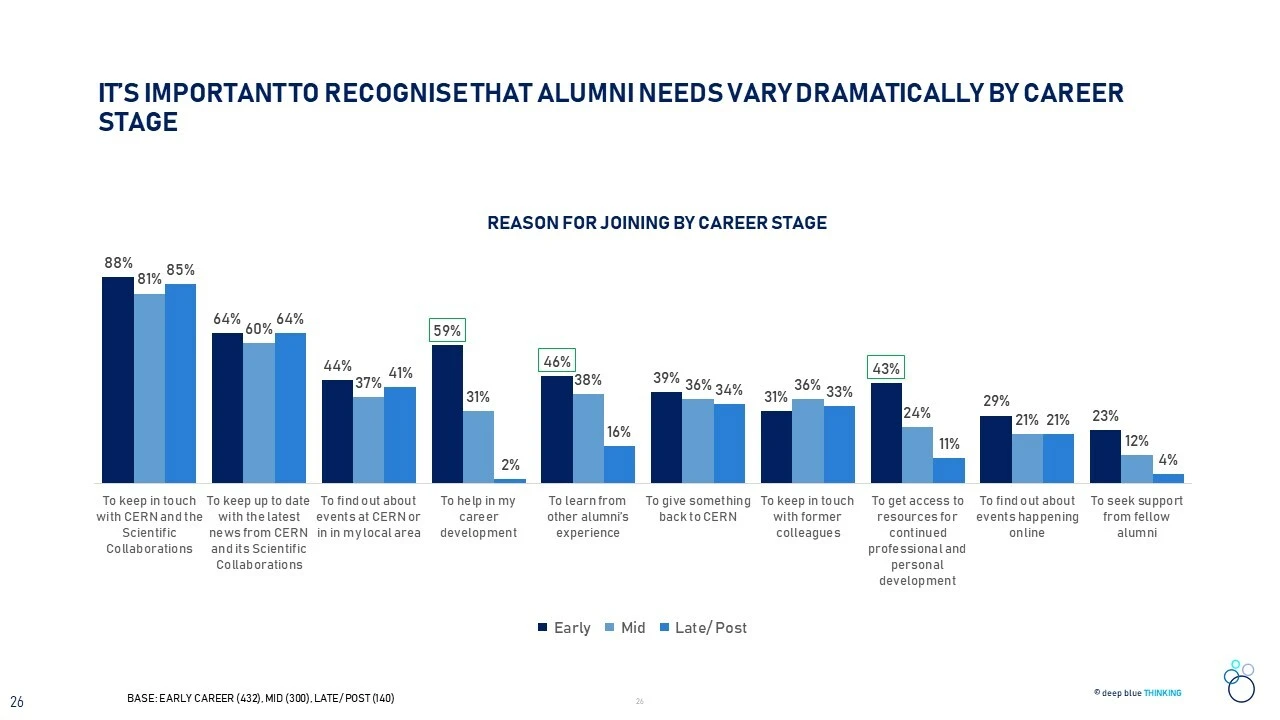
This is also very much confirmed by the analysis of the key drivers for joining the alumni network, illustrated below.
Alumni needs vary dramatically by career stage
Although we were aware of these different needs, the survey confirmed, as illustrated here:
We have chosen to distinguish three personas in whom anyone of you from the network will feel resonance in terms of needs and personal logic.
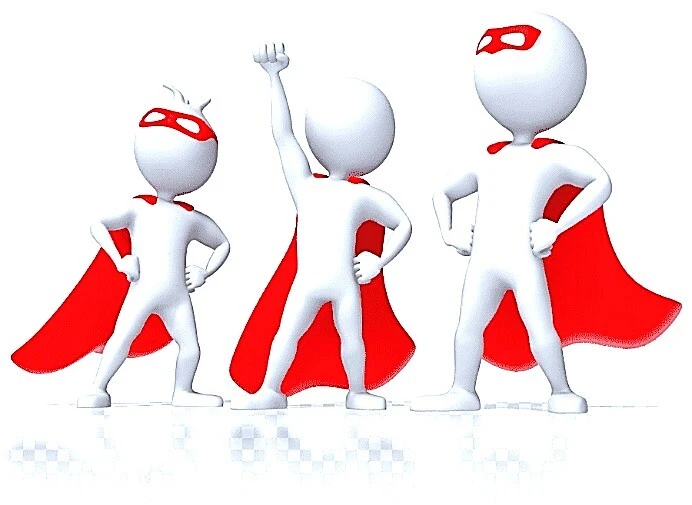
Juan, early career
Juan only left CERN recently and his career is at the centre of his priorities. What Juan expects from the network is support in his next career move. This support may take different forms. He hopes to be able to reach out to other members who may help him integrate a new job, a new sector of industry or simply help him establish in a new location. Juan wishes to keep in touch with his former colleagues for networking purposes. He is also very much expecting events where alumni share their experience and is keen to find a mentor. In his early career, Juan is not too much available to give back to CERN, unless it also helps with his career, for example by sharing his story and placing him in the spotlight.
Sarah, mid-career
Sarah is very much interested in resources which might help her further develop her career. She is already in her third or fourth job and her career is well underway. She knows the full potential of an exclusive professional network and knows how to reach out for support from the Network when she needs it. Sarah is more available to give back, also remembering the support she benefitted form at the beginning of her career. Sarah is available to attend events and also to speak at events and share her experience.
Pierre, late career
Pierre is a happy consumer of news from Particle Physics research and from the STEM world in general. He is not particularly interested in engaging with the community as his interests might have developed into different fields. Pierre is mostly interested in keeping or getting back in touch with former colleagues. He is also more available to give back to support CERN’s mission.
The weekly digest takes it all!
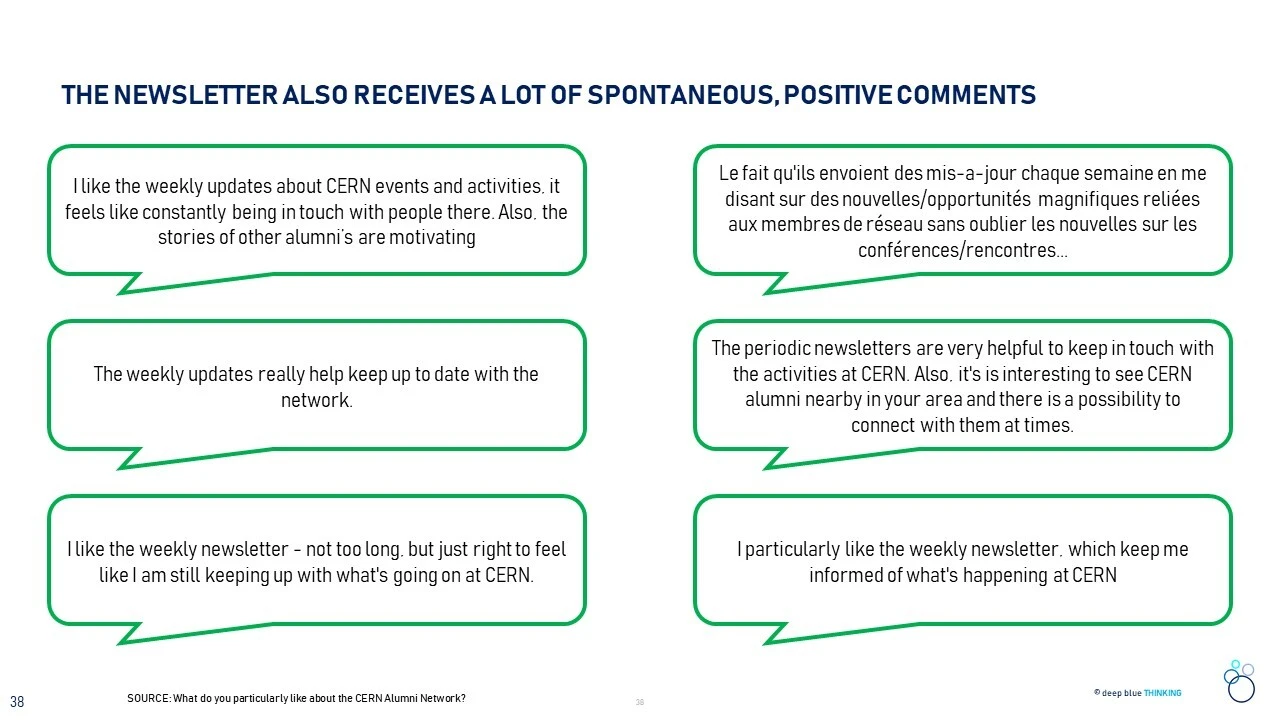
The survey reveals that our alumni are happy consumers of news and the vast majority reads and enjoys receiving the news that we select - and for some produce - for the community in our weekly digest.
What is happening at CERN, news updates from the Lab, academic content such as articles on the latest progress in physics, or innovative technology, and alumni stories, are the content that our community particularly appreciates.
In addition to being the privileged communication channel for 71% of our audience, the weekly digest email also has received a lot of spontaneous, positive comments as illustrated below.
The hard lessons
The survey was not only good news for us and we have had some hard lessons to take from it. It reveals that the expectations, in particular of the early career members, are not met in some of the areas that matter most to them. Receiving support in their career and being able to leverage on the power of the network is something that CERN alumni has not helped with at the level which they expected when first joining.
The graphs below reveals this with, horizontally the expectations of alumni and vertically the extent to which they are met, successively for early, mid and late career members.
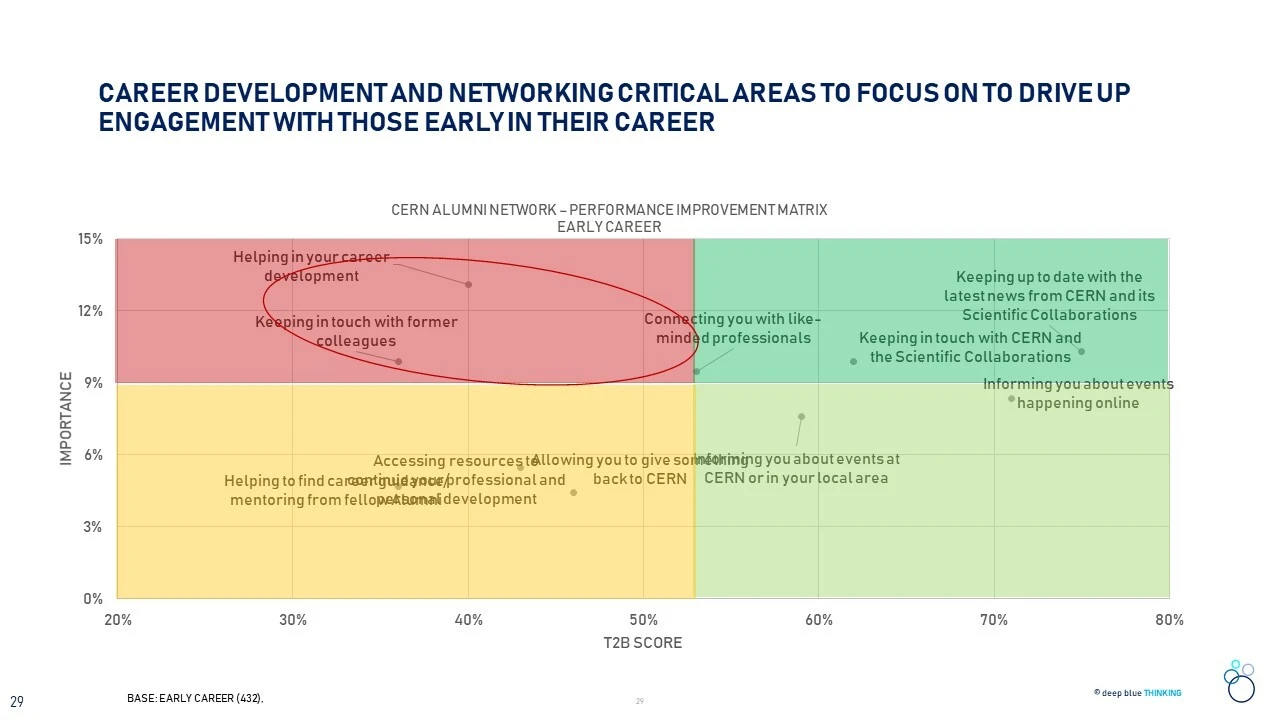
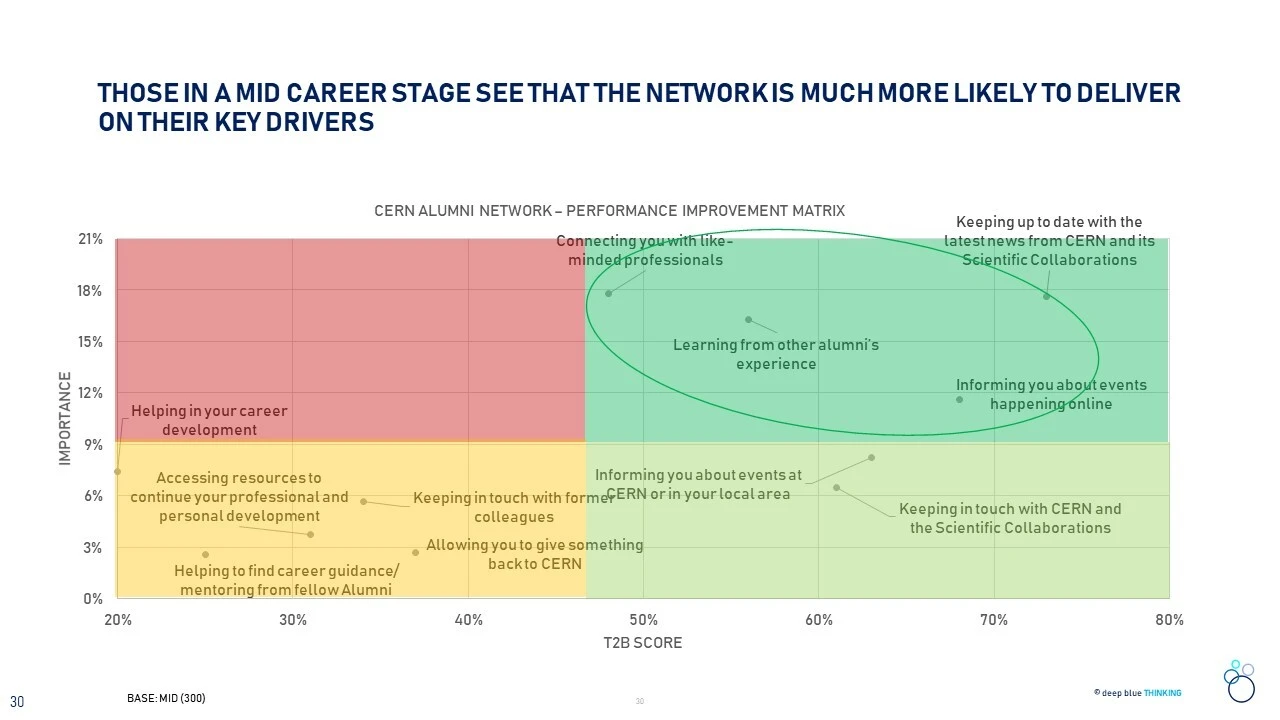
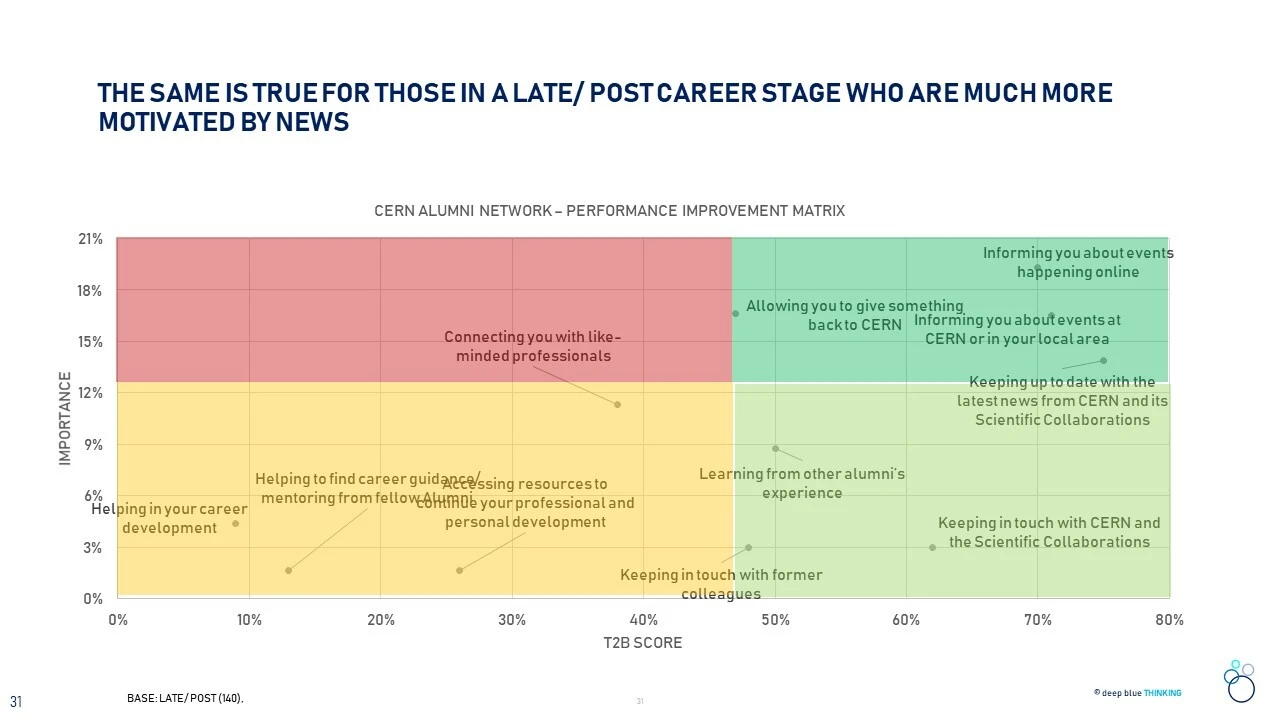
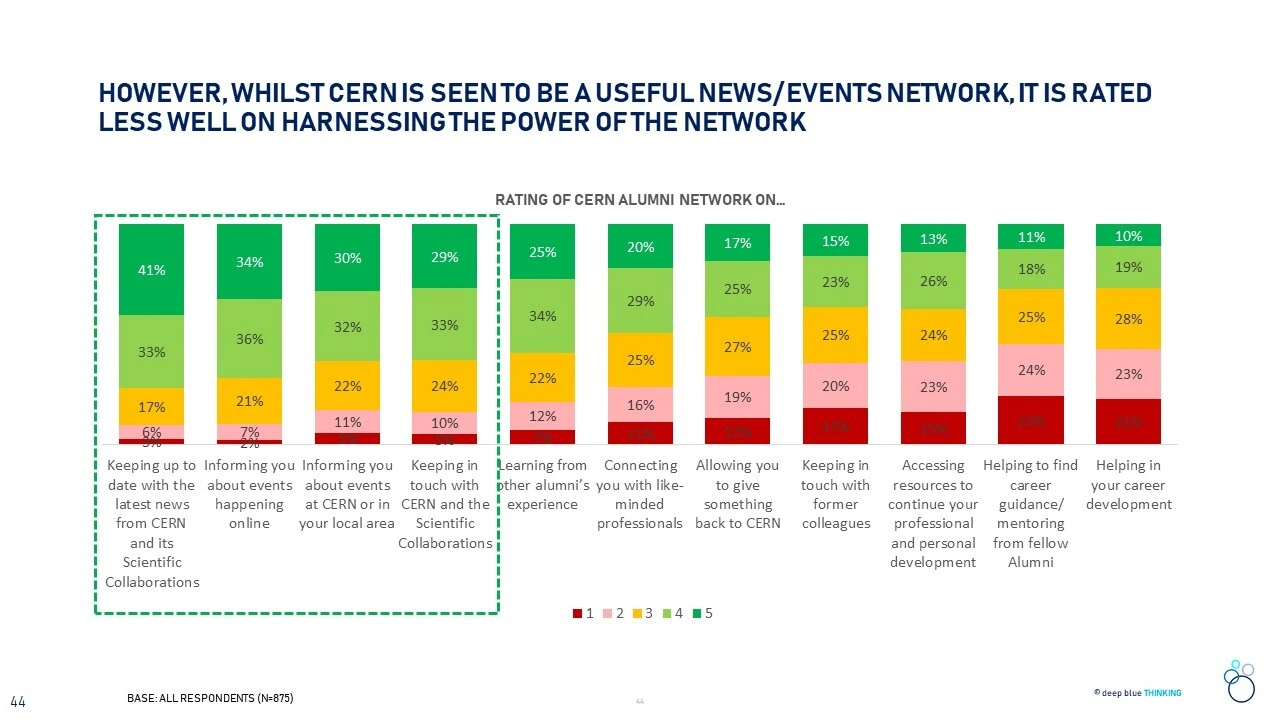
More generally, while CERN Alumni is seen to be a useful provider of news and events for members who are just happy to consume them, it is rated less well on harnessing the power of the network.
Overall, 36% of you are promoters of the network, while one in four of you are unlikely to recommend it. The net promoter’s score (NPS) of 12 is a hard lesson for us to swallow!
A web space that may be improved
You told us that the alumni.cern platform, the space where the community members can interact would really benefit from a number of improvements:
- The process for creating and validating an account to pass through the CERN Single Sign On authentication scheme, is perceived as unnecessarily painful and cumbersome. On this point … we fully agree with you!
- The site offers many features that you are not aware of, what a pity! And amongst you there is zero awareness that there is a CERN Alumni mobile app for you to download from the Google or Apple store.
- The menus could be streamlined and the navigation on the site could be facilitated.
- Etc.
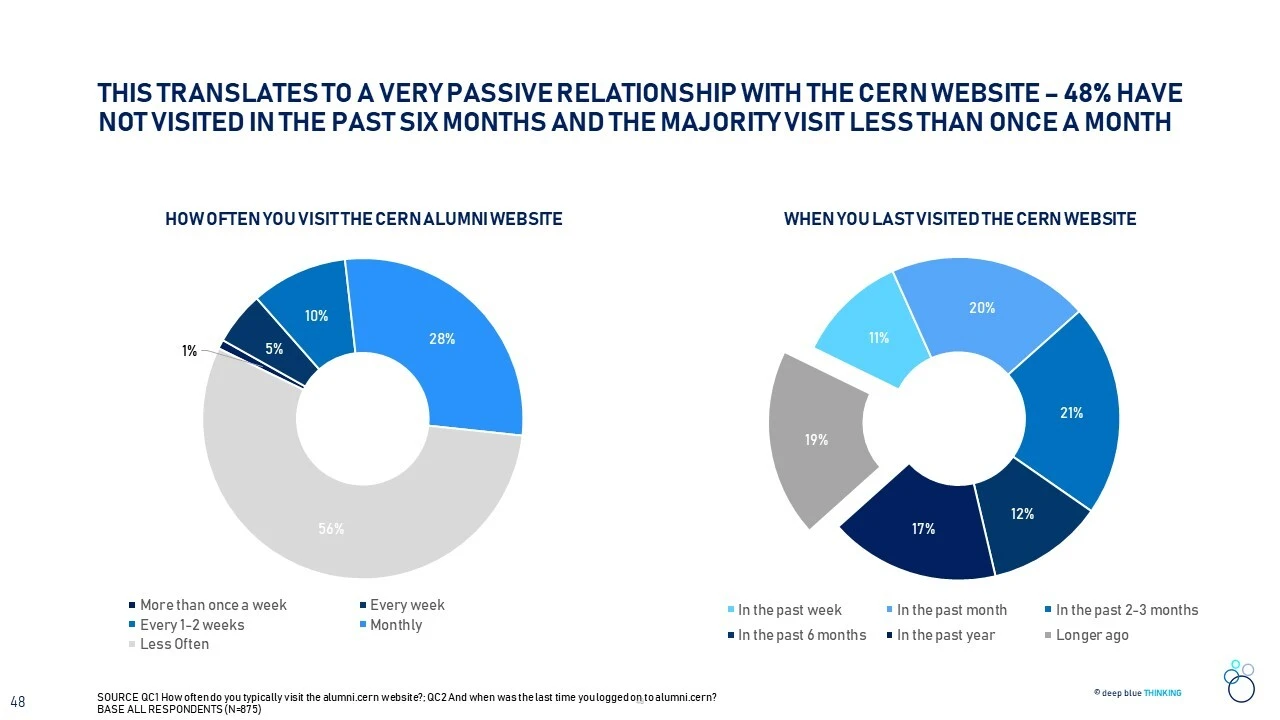
For these reasons and others, the community has a very passive relationship with alumni.cern as illustrated by the graphs below.
Interest groups are in high demand
With its nine regional groups, the CERN Alumni network has very enthusiastic relays in Europe in the United States. Still, despite the enthusiasm of group managers the groups are not yet perceived as very active, especially in this COVID19 stricken world where casual meet ups and in presence conferences have disappeared. Still, there are strong expectations that, in the future regional groups might leave their dormant stage and propose local support and animation to the alumni.
Beyond regional groups the two interests group created so far, Entrepreneurship and Women in Technology, as well as the openlab group, are rated very positively. Many of you told us in the survey that you would be prepared to start a new interest group in fields as varied as Arts & Science, Macroeconomics, Electronics, Mechanical engineering. We will take you at your word and will get back in touch to launch these interest groups!
The calendar of events needs a focal point
The survey also tells us that, despite the many events that we organize or advertise during the year, including our popular Moving Out Of Academia events, you are missing a big annual Alumni event. This event would also be an opportunity for those of you located elsewhere in the world to come back to CERN.
We are happy to let you know that the Second CERN Alumni Collisions will take place in Autumn 2021. While our first very successful Alumni collisions, which took place in February 2018 focused on “a diverse community and the variety of alumni trajectories” these second collisions will focus on “Why research matters and the impact of alumni on society”. Stay tuned for the invitation that will come!
So, what is next?
First, all we should like to thank all of those who contributed. We intend to perform such a survey every three years so as to follow up closely on your satisfaction with the network.
Then, because we cannot tackle all possible actions, we need to set priorities.
We think these priorities in 2021 should be:
- To offer a new version of the alumni.cern web site, more streamlined and easier to navigate menus, making the most of the SaaS online community management software that we are using, Hivebrite (hivebrite.com).
- To grow the network by reaching out to those alumni who have left CERN more than 4 years ago, when the network did not exist. This should allow us to respond to your pressing demand to find more of your former colleagues connected.
- To improve the support provided to the early career members of the community. To achieve this we need your help. Please do offer your help as mentors, post job opportunities which you know could make the most of CERN developed talents, share your stories etc. and provide us with your feedback if you are successful in recruiting CERN talent etc.
- To leverage more on groups. We plan to provide increased support to regional groups and give them additional means to animate their local community. We also plan to start new interest groups on the topics which you have mentioned.
The CERN Alumni Network has demonstrated that it fills a gap that existed between CERN and the scientific collaborations on one hand, and the former members of personnel on the other hand. It has been three years of hard work and exploration of what we could do for you.
The one thing that we know for certain is that we could not have done it without your full support and your engagement! Thank you!
Author: Laure Esteveny , CERN