
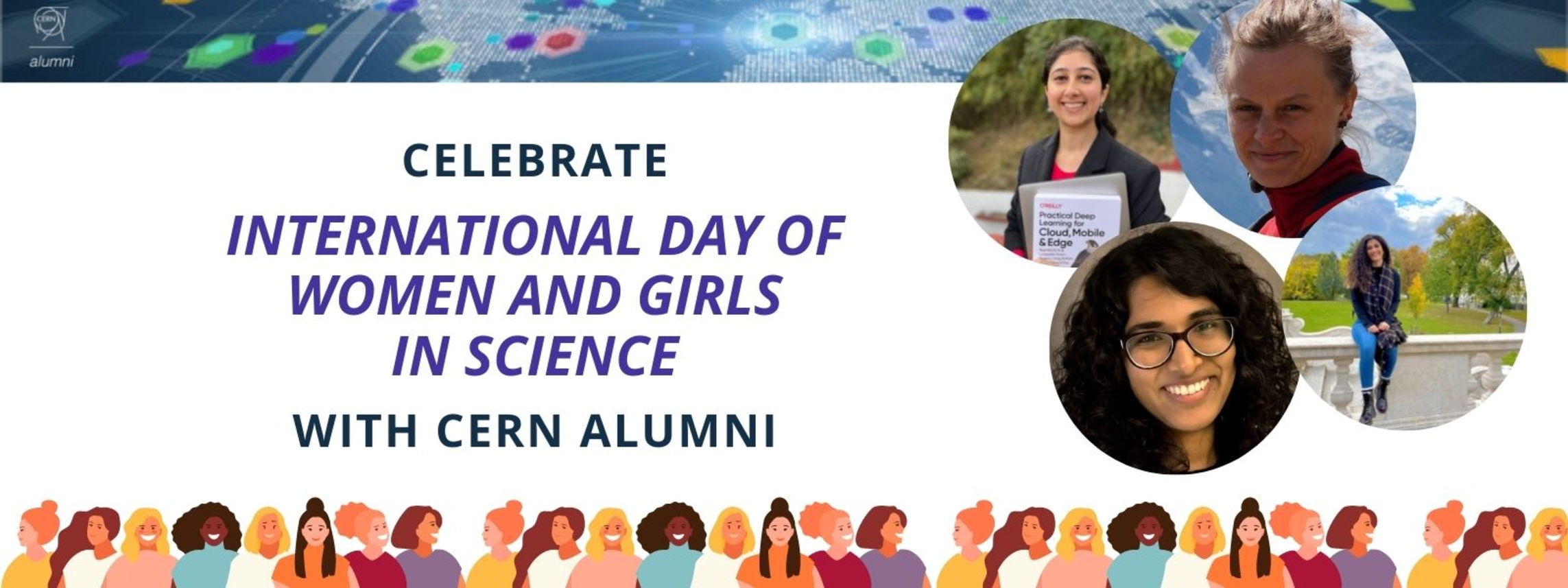
International Day of Women and Girls in Science
The International Day of Women and Girls in Science is celebrated on 11 February to recognise the critical role women and girls play in science and technology and to promote full and equal access to and participation in science for women and girls.
Did you know?
- Women are typically given smaller research grants than their male colleagues and, while they represent 33.3% of all researchers, only 12% of members of national science academies are women.
- In cutting edge fields such as artificial intelligence, only one in five professionals (22%) is a woman.
- Despite a shortage of skills in most of the technological fields driving the Fourth Industrial Revolution, women still account for only 28% of engineering graduates and 40% of graduates in computer science and informatics.
*(according to https://www.un.org/en/observances/women-and-girls-in-science-day )
This year we asked four CERN alumnae to tell us what this day means to them and how they would encourage the younger generation to pursue careers in science.

Working under the LHCb experiment as part of the computing group, Yara Al-Quorashy spent her summer of 2019 at CERN as a summer student. After successfully completing her Master’s degree in Computing Science at the University of Glasgow, as well as a one-year internship at the IAEA in Vienna, she is now about to start a new job in Austria as a Junior Development Engineer.
To Yara, International Day of Women and Girls and Science mean a celebration of women and girls breaking societal boundaries and challenging their own perception of themselves, and what they are capable of.
“There is a lot more work and challenges, which women and girls have to conquer on a daily basis in order to truly express themselves, and this requires a lot of determination, which I always encourage myself and others to do.
There is a quote I read somewhere, which has been really helpful, and it’s along the lines of “say yes to new opportunities and challenges that scare (and excite) you and then figure out the way to do it later.” It really helps me stay grounded and set boundaries for my thoughts whenever I’m about to invite in any self-doubts. The world is so huge and has enough space for all our dreams and goals, so I hope you (and I) always believe that we can dream and live those dreams.”
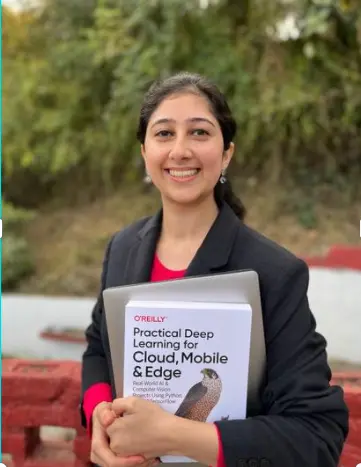
Siddha Ganju’s journey at CERN also started under the flag of the summer student programme. She was working in the IT Department. Her career journey led her to work on exciting projects with machine learning and artificial intelligence on different downstream applications, such as self-driving cars or medical instruments or building an intelligent search engine for the petabytes worth of satellite imagery or detecting comets and meteors with AI.
She is currently working as a Data Scientists for Nvidia, using her AI skills for healthcare applications including medical instruments and piloting research with Life sciences companies.
“The International Day of Women and Girls in Science is a great way to celebrate and bring in fresh perspectives to problems old and new, change previously accepted viewpoints and build solutions that can power lifestyles of the future. To me, investing in Women and Girls in Science is not new, that’s how my siblings and I were brought up and that’s the perspective that I hope is in vogue globally.”
And what message would she send to young girls to inspire them to pursue careers in science?
“Have a goal, plan for it, when you fail, recalibrate. Without planning, you’re not going to get anywhere. So plan. And don’t just plan for success, plan for failure too. Because you’re going to fail. No matter what, no matter when you will fail, so incorporate that buffer and have contingency plans, and recalibrate.”

Lea Richtmann was working in the Machine Protection group of the Technical Department. After the end of her contract, she changed fields and joined the Quantum Control group at the Institute of Gravitational Physics in Hannover, Germany.
What does International Day of Women and Girls and Science mean to her?
"It reminds me that progress is really slow. It also reminds me that we sometimes talk about the struggles of women in comparison to men. However, there are many more genders than only female and male. There is so much in between.”
In Lea’s opinion, instead of focusing on the individual level by telling young girls how they should behave to fit into the current structures, she asks whether institutions like CERN are willing to change their work culture to become more welcoming to everybody.

Aditi Chandra was also a summer student in 2012, working on the ALICE experiment. After that, she completed her master’ degree in nuclear science and engineering from MIT, and a master’ in management from London Business School. She is currently leading the design and manufacturing of equipment for nuclear power plants in India as an Executive Director of Kay Bouvet Engineering.
Aditi has also founded Nisaba Education, a science education initiative on a mission to inspire the next generation of scientists in India. “Through this initiative, we invite scientists from all around the world to conduct live online workshops for young children in India. The scientists interact with the kids, talk to them about their research, and introduce them to the fascinating world of science, from particle physics to black holes!"
“International Day of Women and Girls and Science is an opportunity to celebrate and highlight the amazing achievements made by women in the field of science. It is also an opportunity to encourage and inspire even more women and girls to pursue careers in science. And my message for young girls would be: Let your curiosity run wild. Don’t be afraid to ask questions. Our universe is a beautiful and mysterious place, and you are an integral part of it. Explore it, study it, and you will discover something amazing around every corner!”