
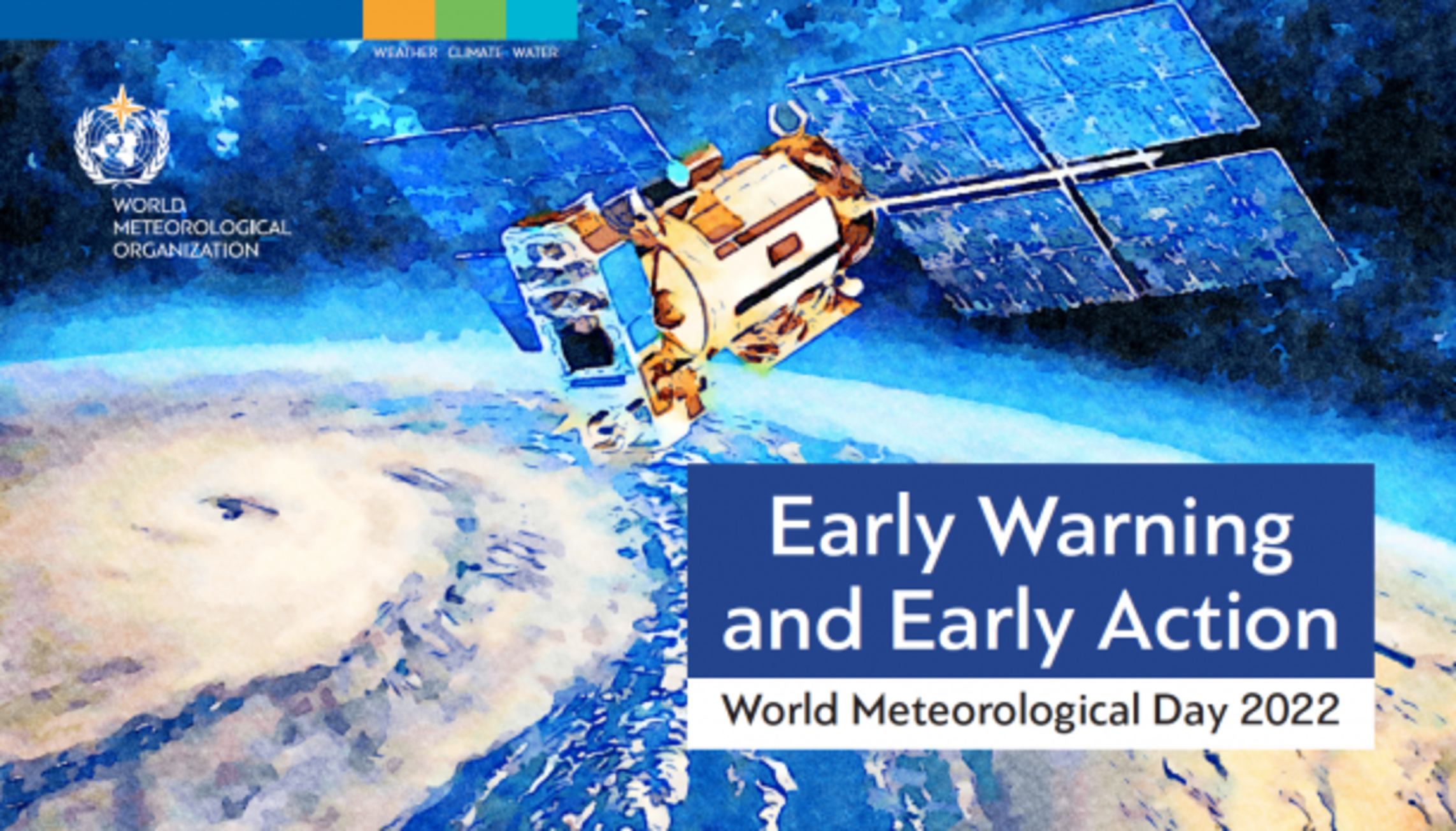
World Meteorological Day

Weather, climate and water extremes are becoming more frequent and intense in many parts of the world as a result of climate change. More of us are exposed than ever before to multiple related hazards, which are themselves evolving as a result of population growth, urbanization and environmental degradation.
COVID-19 has complicated the challenges facing society and weakened coping mechanisms. The pandemic has also highlighted that, in our inter-connected world, we need to embrace a truly multi-hazard, cross-border approach to make progress towards global goals on climate action, disaster risk reduction and sustainable development. 1
World Meteorological Day 23 March 2022 has the theme Early Warning and Early Action, and spotlights the vital importance of Hydrometeorological and Climate Information for Disaster Risk Reduction.
This day is an occasion to highlight some of the great work CERN alumni are undertaking in the field of meteorology.
Let us introduce you to our CERN alumnus, Jonathan Gregory, climate scientist, employed since 2003 at the National Centre for Atmospheric Science in the University of Reading (where he is a professor in the Department of Meteorology), and since 1990 at the Met Office Hadley Centre (currently as a Science Fellow). He changed his area of research after his PhD in experimental particle physics (at CERN) because of scientific interest in and personal concern about climate change caused by human activities.
He studies large-scale multidecadal physical processes of change in the climate system, using three-dimensional global models and observational evidence. He has made significant contributions to refining the concept and the evaluation of climate sensitivity (the magnitude of warming caused by increases in greenhouse gases), and to the projection of future sea-level change from ocean warming, ocean circulation change, and loss of ice on land (glaciers and ice-sheets). He was a lead author of the last three Assessment Reports of the Intergovernmental Panel on Climate Change. He is one of the leaders of the World Climate Research Programme's Grand Challenge on sea-level change.
Jonathan was given the CERN Alumni Directorate Award during our Second Collisions event. He was nominated by the CERN Directorate for his illustrious and impactful career following his departure from CERN: “This is an entirely unexpected honour, which I sincerely appreciate. Although it was long ago, I have clear and positive memories of the excitement of working at CERN, where I was on long-term attachment in 1987-1988 during my PhD. I haven't studied particle physics since I finished my thesis, but I also learned statistics and computing at that time, made friends and began alpinism, all of which are part of my life today. The unusual trophy reminds me of the inventiveness of CERN and I am glad to have it.”