
10 questions with Christos Bakalis
At CERN: PhD Student
Today: Electronics Engineer at Lawrence Berkeley National Lab
1) When did you work at CERN (including its Scientific Collaborations) and what did you work on?
"I worked at CERN from July 2016 until August 2020. I was a member of the ATLAS collaboration, working on the New Small Wheel upgrade. I was a PhD candidate under the National Technical University of Athens, and worked primarily on the electronics R&D of the upgrade."
2) What is your best memory of working at CERN?
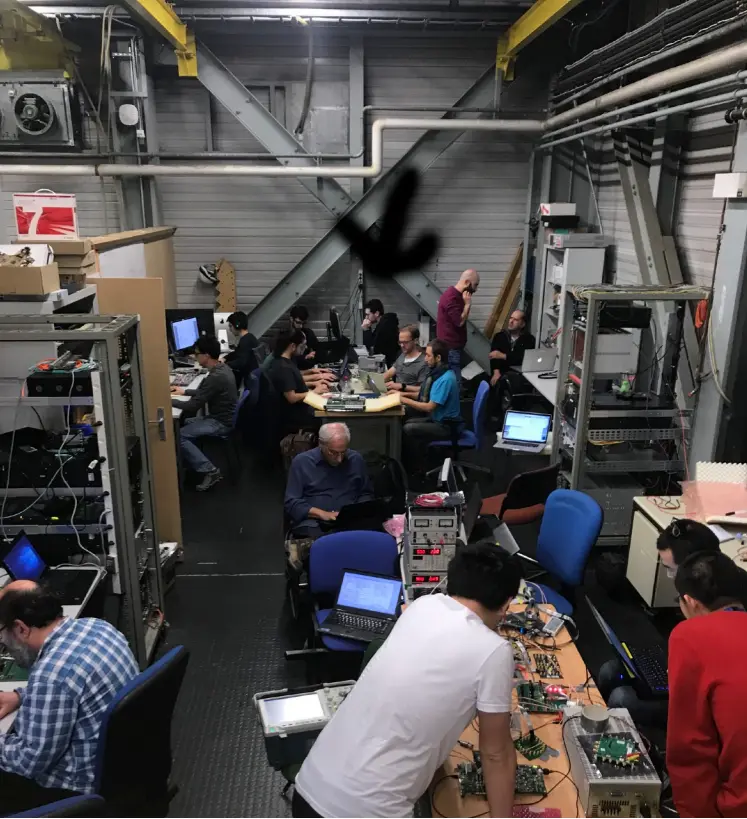 "The first thing that comes to mind (I am sure there are more), was managing to integrate a newly-arrived electronic chip with the rest of the data acquisition system which was very complex. My colleagues and I had to do a bunch of workarounds and kludges to prove that it can work - that was hard honest work, and we all celebrated after we saw that it worked. These moments go to show that collaborating and working in a team makes things easier and can amplify the feeling of joy in situations like this. Memorable moments (CERN and non-CERN related) had always been within those lines for me."
3) What is your current job and where is it located?
"I work as an Electronics Engineer at the Lawrence Berkeley National Laboratory, in the San Francisco Bay Area in the United States."
4) What skills did you develop during your CERN work experience which have been particularly useful in your subsequent career trajectory?
"Technical skills that I developed during my tenure at CERN have been very helpful indeed. These things are not taught in school, and one can only acquire them through hard work. The most important skill that I developed whilst working at CERN that proved useful was learning how to work in a team environment, and learning that it is always better to engage in that, as opposed to working alone."
5) Which skills (if any) did you need to develop further when you left CERN to face your next professional challenges?
"Because I was hired by my current employer during covid times, I had to develop the skill of working remotely. This has been a major challenge for me, as working on-site is something that I prefer to do, but I had to slowly adapt to it, as this is the new norm."
6) What tips would you give to someone who is considering a career transition from academia to industry?
"I am working in a quasi-academic institute, so I have no comments here. Maybe I will come back and answer this in a couple of years!"
7) What advice would you give your younger self?
"Stop worrying so much - you are much better in this than you think."
8) Do you still keep a close eye on what’s going on at CERN?
"Yes. I follow newsletters and I am in constant contact with ex-colleagues, and I always lend an ear when they have something important to tell me (this usually comes in the form of nagging and complaining about things not working :) )."
9) In your opinion, what is the unique value of the CERN Alumni Network?
"The unique value of the CERN Alumni Network is that it allows people from a large scientific group to connect and discuss their future in the field or in the industry, and find new jobs. Also, during covid times, I have come to appreciate socialising even more than before - and the network can help with that."
10) Imagine you are stranded on a desert island. You can have one piece of music, one book and one luxury item. Which music, book and luxury item would you choose and why?
- Music: The first Dire Straits album, because it is very chill,
- Book: The Grapes of Wrath, because I am reading it right now and wanna finish it for sure,
- Luxury Item: a car. Gotta sleep somewhere and would like drive around once every year to remember the good old times.