
Building a Fulfilling Career, with Some Fun Along the Way
At CERN: UPSA- RE88 in 1997
Now: Engineering Manager at Rivian
Andy Belk reconnected with CERN and the Alumni Network when he joined the CERN Alumni San Francisco Bay area regional group earlier in 2022. The group launch was a perfect opportunity to find out more about Andy’s CERN experience in the 1990s.
Andy explains his first visits to CERN were to conduct beam tests for the ALEPH inner tracking chamber: “The first time I came to CERN was for a beam test. I was doing my PhD at Imperial College and I was working on the inner tracking chamber for ALEPH. Travelling to Geneva from the UK, I recall we carried the circuit boards for the data acquisition system that we were testing with us on the plane. I remember simply carrying them in our hand luggage, because back in the day, which was pre-9/11, it was possible to walk into the airport with these complicated circuits and nobody blinked an eye."
Early on at CERN Andy faced a challenge which required immediate action – he was told a data acquisition software he had spent two months writing in Fortran had to be written in C, because Fortran was no longer supported.
“We had two days to rewrite it and if we ran out of time, we would have to schedule another test and it would put the whole project back months. I talked it over with my colleagues and we decided to rewrite it. I started at about 3 o'clock in the afternoon and I was up until about 9 am the following day and once we finished, I went to the swimming pool opposite CERN and slept for most of the morning."
Andy explains the conflicting impression he had when he first came to CERN.
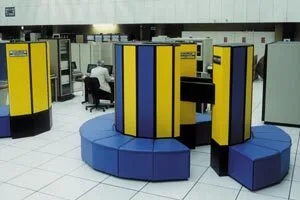 “I remember being both impressed and unimpressed. On one side, I was able to wander around the CERN Computer Centre where I saw the CRAY supercomputer. People do not appreciate it these days, but CRAY was an impressive blue and yellow octagonal structure, it was simply an amazingly cool-looking computer. And of course, I was impressed by seeing the detector and going down into the depths and seeing the ring.
But on the other, less impressive side, all the buildings were just bland, because this was before a lot of the newer buildings had been constructed, everything was dated from the 50s and 60s. However, in the end, the impression that I got at CERN, was that the budget was essentially spent on science and scientists were more interested in good equipment and computing power in order to do their experiments, rather than fancy furniture.“
Andy came to a crossroads a year into his CERN experience when ALEPH and LEP announced delays of one year. He was working on the data acquisition system at the time and by doing the maths, he realised that his PhD funding would end before the experiments started and that left him with the possibility of trying to do a physics PhD with no physics.
“I chatted with John Harvey and Wolfgang von Rüden (who was in charge of the data acquisition system), they were happy with what I was working on and knew it was key to data taking and beam tests, and they decided to sponsor me. This allowed me to take a leave of absence from my PhD, suspend the funding and extend it for a year, which meant I could stay and continue to do my work and that also meant that I would have data to work on my thesis and not have to leave CERN.“
Throughout our interview, Andy entertained us with stories about his broken-down cars and fixing them. His passion for cars became very clear. As well as leaving him with some entertaining anecdotes he can now share, these activities helped with his career, which he explains further.
“Around CERN and the Geneva area, if you say you work for the UN or you're a physicist working at CERN it's rather boring because almost everybody does. Since I had been buying all the used vehicles and fixing and upgrading them, every time I went to parties, I started telling people that I was a used car salesman because it was more interesting than being a physicist. Thinking back about my experiences at the CERN car club and working on all of those used cars, I really think this has helped my software development.
When you work on a vehicle, you must plan ahead, because if you are missing something or you break something, you're done. And this gave me a lot of confidence with regard to writing software because with software, you can always experiment, and I learned that is one of the things that distinguishes software development from hardware. It is much quicker to experiment, try something and then undo it, than to spend too much time planning and thinking ahead and that has impacted the way I work and the way we do software development in my team.
I find it very interesting to realise what ended up being impactful for my career. The ALEPH team on the data acquisition system definitely helped me with the software structure design. But the confidence, the methodology and the philosophy were certainly impacted by working on cars.”
Towards the end of his fellowship, Andy started learning to program in Objective-C and as he explained proudly, he was one of the first users of the World Wide Web using the WWW browser and editor that Tim Berners-Lee had written on the NeXT. But it was time for him to say goodbye to CERN and move on to the next adventure.
“Learning a bit of Objective-C gave me some real insight into object-oriented programming and having experience with NeXT is essentially what got me into my career at Swiss bank where I worked on trading systems which were built on the NeXT platform. One time, Steve Jobs was coming to visit the Swiss bank, which was a big NeXT customer and he gave a talk about their enterprise objects framework. After the talk, I found myself in an elevator with him and I decided to bring up some issues with this technology, so, in other words, the first time I met Steve Jobs, I had an argument with him.
Eventually, I quit Swiss bank and went to work at NeXT in the USA. Ultimately, NeXT was purchased by Apple and we merged, and then I spent nearly 24 years at NeXT/Apple.
One funny story, which was a secret until now dates back to when I was in the department working on iPhone sync and I remember saying out loud: “There's no way Apple stock will ever reach [a certain] number, and if it does I’ll buy everybody lunch!” My department admin overheard this and sent out a department-wide email saying that if Apple stock hit this number, I was buying everybody lunch. Well, it so happened that the stock price did it because Apple with doing rather well, and so I had to organise this big lunch for around 80 people.
I decided to organise a Halloween lunch, and as part of the Halloween theme, somebody had bought a smoke machine. Unfortunately, the machine set the smoke alarm off and we had to evacuate the building temporarily. And one of the people who got evacuated was Steve (Jobs), who had to break off an important lunch he was having with Johnny Ive, chief design officer at Apple.”
After an impressive and fulfilling career, Andy explains he started considering retirement in 2021. However, his friends warned him against taking such action immediately.
“Last year I started considering retirement and I talked to some friends who said I couldn’t retire because I would get bored. And I realised, they were right. So I started thinking of other options."
A common interest/thread in his life Andy explained previously, cars and in particular electric vehicles drove him to start working at Rivian, the electric adventure vehicle company.
“This is a company that is solving a real problem, which is getting people out of the gas-guzzling into electric-guzzling pickups to start using cleaner energy. Even though they're not the most efficient vehicles yet, they are still so much more efficient than gas pickups, so getting people out of gas pick-ups into e-pickups is a much bigger environmental win. As a big environmental enthusiast and somebody who wants to leave the world better for my kids, I decided to give it a try and I was hired to work for Rivian and it's been a really interesting ride so far.”
Andy is currently an Engineering manager working with a team developing vehicle features such as alarms, immobilisers, notifications from the car to the mobile app. “In addition, thanks to my previous experience with Apple maps, I’ve been working on the navigation aspect as well, because this has proved to be helpful to the team.”
Reflecting on his career, Andy concluded that it was important for him not only to grow professionally, but also to enjoy the work he was doing. And if he could change anything or give a message to his younger self, what would it be?
“Buy Google stock, buy Apple stock. If I had done that, I could have retired a lot earlier :)
And more seriously, in terms of my career, every few years while I was at Apple, I interviewed, and I looked around at other jobs and kept an eye on what was going on in the job market. And then I decided to go with my gut and that led me to stay in Apple for the large part of my career.
Most of my co-workers from 25-30 years ago at Apple are now directors and VPs or SVPs at Apple.
In one sense, I’ve done something different from them, but I’ve also had the ability to work on a whole bunch of different things that's been very interesting. I’m probably not worth as much money as many of my colleagues, but maybe I’ve had more fun.
The work that I did at Apple, whilst it does not directly contribute to humanity’s growth, I do think the fact that the MAC, macOS and the phone exist, have enhanced people's lives somewhat.
I'm not sure that all the things have been good, but that's probably true of absolutely any technology that we have developed. Personally, I find that the ability to send emails from my phone and call people has helped me stay in touch with friends and colleagues from around the world. And for someone who has a lot of friends, especially because I was at CERN and have friends all over the world, that's been a good thing for me.”
Speaking about staying in touch, Andy elaborates on his thoughts on the CERN Alumni programme.
“I am quite a gregarious person and I like having lots of friends and people with different personalities and viewpoints - I think that aspect of the Alumni network, getting to know some of the other folks who've been at CERN, is a benefit to me personally. Professionally, as I am almost at the end of my career, I am excited to offer mentorship or consultancy to people in the alumni network.”