
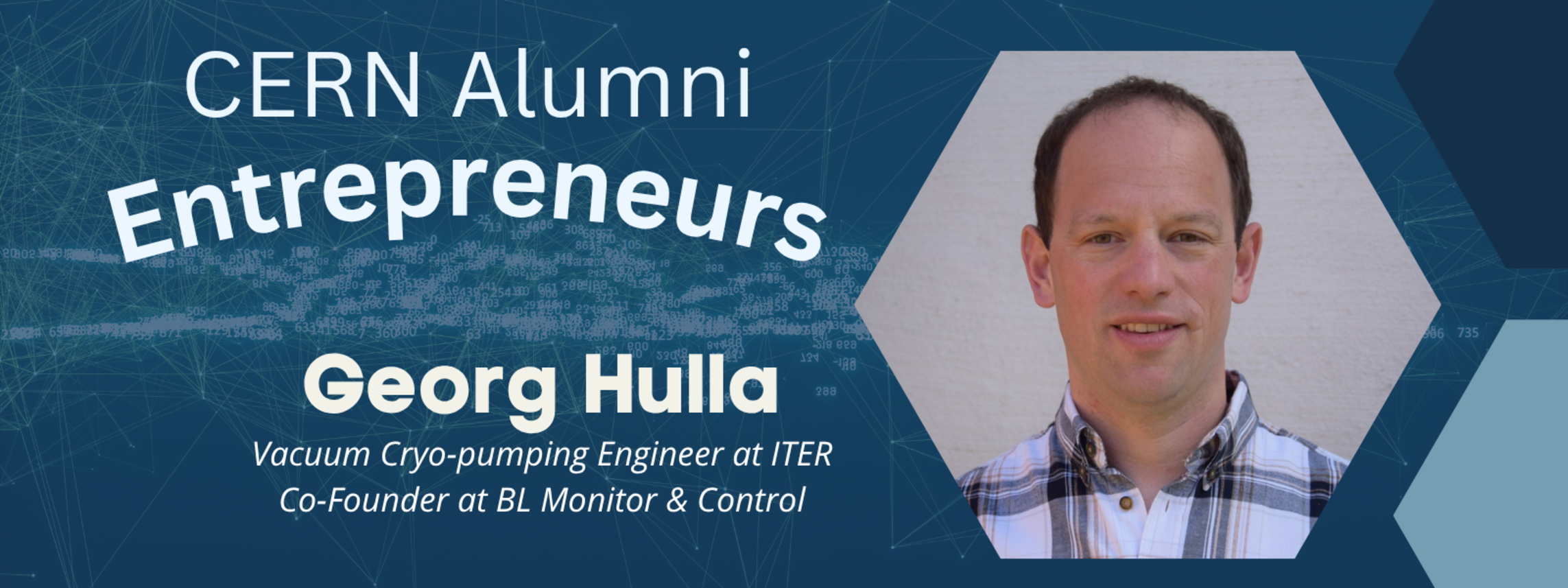
Controlling accelerators and beyond from your own pocket: Georg’s innovation journey
At CERN: Trainee, PhD student, 2006-2008 / Associate, 2009-2013 and 2016-2020
Now: Vacuum Cryo-pumping Engineer at ITER / Co-Founder at BL Monitor & Control
CERN Alumnus, Georg Hulla and his partner David McGinnis are pioneering a shift toward Lab-as-a-Service (LaaS) with a revolutionary, open-source remote access framework designed to decouple scientific hardware from the physical control room, an approach inspired by experience Georg gained at CERN.
at CERN alongside Helmut Schönbacher,
October 2005 (source: Georg Hulla)
After some initial hesitation, Georg came to CERN from Austria in 2006 on a PhD exchange in Vacuum Systems Engineering - a decision that would change his life: "At first, I was hesitant to go to CERN, I must say that the old barracks where I stayed didn’t really help in this regard! But my father was able to convince me to give it a shot, as it represented a great opportunity." It certainly was as he developed a deep appreciation for his work and committed himself to learning French (eventually dreaming in la langue de Molière). His efforts paid off as he integrated into the CERN and local community. Georg describes working with people from across the globe in a truly international project as a life-changing experience - one that continues to shape him to this day.
However, while working on his test setup for ion-induced desorption measurements related to future LHC operations, Georg encountered significant challenges. He was required to design and implement a control system (HW & SW) for an ion source – a device that generates a charged particle beam - a task of considerable complexity. The process took over a year to resolve, as he initially lacked the expertise and support needed to set it up, consuming substantial time and resources. This challenge ultimately became the foundation for the technology he would go on to develop in the years that followed, allowing engineers to get started on their experiments without having to wait for the precious support from specialised control experts.
January 2006 (source: Georg Hulla)
Leaving CERN and seizing new opportunities as an Alumnus
Georg became so well integrated into the CERN community that he was reluctant to leave. However, after finishing with his PhD, the time at the Organization came to an end and in December 2008, he was offered to join MedAustron, a hadron therapy centre to be built in Austria and developed in collaboration with CERN. This marked a particularly rewarding phase in his career as he was able to collaborate with a very motivated team and apply the core skills he had acquired at CERN for the development of a medical accelerator, designed to serve patients and society at large.
After 5 years at MedAustron, during his time as a CERN associate, Georg decided to pursue a new opportunity in Sweden at the European Spallation Source (ESS) in Lund, where he joined the Vacuum section. Shortly thereafter, through a connection with another CERN Alumnus based at ESS, Georg met David McGinnis, who is now his partner at BL Monitor & Control. The two immediately recognised a shared ambition: to apply their innovative expertise in ways that would benefit society. They began considering the launch of their own company, seeking the flexibility and independence to bring their ideas to fruition.
The “lightbulb moment” occurred when Georg saw David and his colleagues operating complex and costly machines using nothing more than their mobile phones. For someone trained as an applied physicist – accustomed to large-scale control rooms and intricate infrastructures (unlike those he had struggled with during his PhD at CERN), this was a genuine game-changer. He quickly realised that further developing and spinning-off such wireless and secure control platforms held enormous potential. The technology could be adapted for a wide range of societal applications, improving collaboration, reducing costs and enhancing safety.
As for the name, that came out rather quickly. Colleagues joked that they looked like school children building a homemade science project to make lights blink: And so Blinky-Lite was born.
Blinky-Lite and its potential
The development of their platform progressed rapidly, and before long, the entire test facility at ESS was running on their technology, which served as a proof of concept. One of their first commercial assignments at BL Monitor & Control however, was far from conventional, as it took place … in a sauna. The iconic wellness installation is located 1km off the Swedish coastline and is recognisable from well-known IKEA posters. In November, after braving the icy waters of the Öresund, they installed a remote monitoring system enabling the local community to have access to water temperature and sauna attendance. The result was a resounding success, and the website reached hits far beyond the borders of Sweden.
the sauna, May 2021 (source: Georg Hulla)
Unlike traditional control systems, Blinky-Lite replaces the traditional requirement for 24/7 onsite operations teams with a secure, "Edge-first" -driven framework enabling engineers in charge of dedicated systems to remotely take corrective actions without compromising safety standards.
The platform is built on a free open-source framework under an MIT-licence and its architecture facilitates straightforward deployment, customisation and scalability without the overhead.
Georg and David soon expanded their technology into other projects, including an accelerator-based boron neutron capture therapy (BNCT) unit in Hungary and a high-power, conduction-cooled Superconducting Radio Frequency (SRF) accelerator tailored for industrial applications at Fermilab. As they are already extending into both medical and industrial applications, the potential use cases are vast - spanning next-generation accelerator facilities and far beyond.
Change the mindset concerning control systems
One of the main challenges Georg and David face is a clash of mindsets. Many accelerator facilities as well as the industry, still rely on systems designed in the twentieth century, and some experts remain hesitant to adopt newer technologies such as Blinky-Lite. In some cases, its potential is underestimated; in others, there are misplaced concerns about security: "If you can manage all of your banking operations from your mobile phone and in a very safe way, then it is possible to control an accelerator from your own pocket or your laptop".
Addressing this cultural resistance is now a central part of their work. Georg and Dave are actively promoting their innovation and engaging their professional contacts - including the CERN Alumni Network - to encourage a shift in perspective around modern, secure and scalable control systems.
Having successfully deployed this model across multiple high-stakes projects, they are now inviting the CERN Alumni Network to help scale this "Lab-as-a-Service" ecosystem. They are seeking collaborators to explore new implementations and collaborative development opportunities, ensuring that the next generation of startups, researchers and engineers can access beamlines, experimental stations and test rigs as easily — and safely — as they access the cloud and without creating a VPN “hole” in the firewall which is increasingly a liability. If you are interested, please contact Georg via the alumni.cern platform.
Want to find out more?: blinky-lite.org