
Career transition from CERN to Industry - Andrea Dotti
Moving from CERN to industry is a path many alumni have walked, but it's rarely straightforward. How do you make your research experience resonate with a recruiter? What belongs on your CV, and what doesn't? How do you prepare for interviews where no one has heard of ROOT or GEANT4?
In this series, we ask alumni who have successfully made the transition to share what actually worked for them - practical advice on job searching, CV writing, and interview preparation, drawn from real experience.
Whether you're actively looking, just starting to think about it, or simply curious about life beyond the Lab, we hope these conversations help you take your next step with confidence.
CERN Alumni: Andrea Dotti
At CERN: User 2002 - 2008, 2016 - 2018
Fellow/Graduate 2009 - 2012
Associate 2012 - 2016Now: Head of R&D at PIX4D
What was your role at CERN, and what are you doing now?
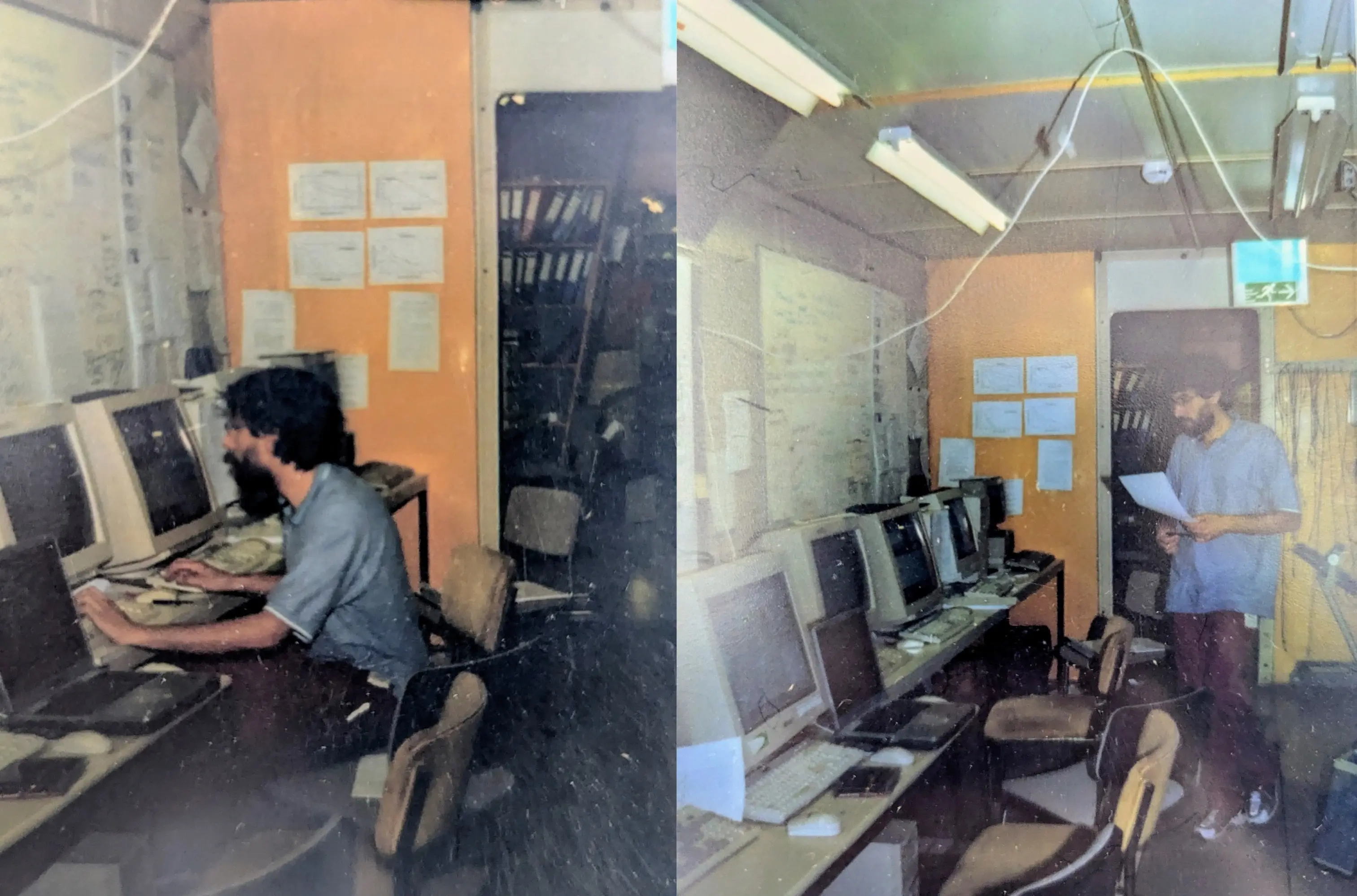
"At CERN, I have been a Fellow, during which I was involved with the Gean4 simulation. I have also been a USER in the ATLAS experiment.
Currently, I am Head of R&D at a company specialising in photogrammetry solutions. My work is to coordinate the activities around computer vision problems."
What aspects of your CERN experience turned out to be the most valuable when applying for industry roles?
"The top-three most valuable experiences from CERN, according to me are:
- Problem-solving skills for a weakly defined project. Basically, being able to navigate a complex problem where a clear solution needs to be found. Design it, guide the implementation and measure its success.
- The soft skills learned working in a highly international environment like CERN have been very appreciated in an international company with different offices and distributed personnel.
- The strong scientific mindset and data-driven attitude to solve problems is very appreciated in specific industry roles."
What elements are ‘must-haves’ on a CV in your sector?
"Show adaptability and interest in learning new methods and technology. Often, industry uses very different technology stacks and processes that need to be learned quickly. Do not try to learn them beforehand, unless explicitly required in the job opportunity, but show that you can learn quickly.
A person coming from CERN is probably searching for a highly technical job. Showing strong maths, engineering and in general scientific skills is usually appreciated.
Demonstrating the ability to communicate complex concepts to a non-technical audience (e.g. customers, non-technical stakeholders) is a key asset."
What common mistakes do you see CERN people make when writing their CV?
"A long list of publications and, in general, not adapting the CV to a non-academic role, using technical jargon without clarifying the impact of what has been done.
Focusing too much on what was achieved but not enough on the specific contribution of the individual (e.g. "Participate in the building detector X" should be "I was responsible for ABC, supervising N people in a team of N scientists.")
Not using enough hard metrics to convey success (e.g. write "wrote an analysis that can process XX TB of data in XX days" instead of "Wrote an analysis for the entire experiment dataset."
How did you prepare for interviews outside the research environment?
"At the time I used Google to search typical questions at the different steps of the interview (e.g., HR interview, technical interviews).
Today, AI systems can probably do a better job in helping prepare for interview(s).
In all cases, it is very important to study the available material online on the target company (e.g. blog posts).
Prepare in advance a good number of questions for the different roles during the interviews (e.g. benefit packages questions for HR, examples of work days to the technical team, and how decisions are made to the manager). "
What advice would you give someone at CERN who is starting to explore industry jobs?
"The first step should be to discuss with friends and acquaintances who are already working in the industry. Define your key values that you cannot live without and trigger your decision to consider a move (i.e. work-life balance, economic security, long-term prospects) and see which industry and sectors are a better fit based on your priorities.
At the beginning of the search for a new job, it is beneficial to apply for multiple positions even when they are not a perfect fit. It is very important to get a bit of experience in the process of searching for a new job as early as possible."
What do you suggest people should start doing before leaving CERN to make the transition easier?
"Work on the CV well in advance, keeping two or three variants tailored for different roles (e.g, a CV for a Software Engineer will look slightly different from a R&D Engineer with different highlights).
Create a "personal DB" with contacts, names of industries and specific companies of interest.
Curate and use platforms like LinkedIn, even if it is objectively difficult to find a job through these systems, it can be useful to build a network and get inspiration on what a specific industry is doing."
What resources (people, platforms, courses, etc.) helped you the most during your job search?
"The most useful resource is a personal network. CERN can help a lot with this because the network is so large and spreads around the globe. Online platforms like LinkedIn can help to complete the view, but the expectations should not be very high.
Depending on the seniority and detailed job description, online courses to complete the profile are a possible addition, but I would spend the minimum possible amount of time on them.
Unless explicitly requested and of high personal interest, I would not invest money or time in specific certifications."
Share one sentence from your CV that you rewrote to make it more understandable outside CERN
"I worked on a hadronic interactions model for ATLAS simulations and made it substantially faster. The overall simulation got about 10%. Since this was run on production on the grid, the same result became "Optimised physics simulations on distributed resources producing a saving of 1M US$/year". I asked the computing coordinator for some data on how much time was spent globally on the grid and made some efforts to have an estimate of the savings induced by the change. The goal was to express in terms of something that a recruiting manager can easily grasp."
Your turn: Made the leap from CERN to industry?
We'd love to hear what worked for you. Every career journey is different, and your story could be exactly the nudge a fellow alum needs to take their next step.
Share your experience here.
Looking for more career resources?
Head over to our Media Centre, where you'll find recordings from previous career events and resources recommended by fellow alumni.
Know of a resource that helped you and should be on the list? Let us know at [email protected], we are always looking to grow this collection for the community.