
LHCb discovers the final missing member of a doubly charmed particle family
Published on June 19, 2026
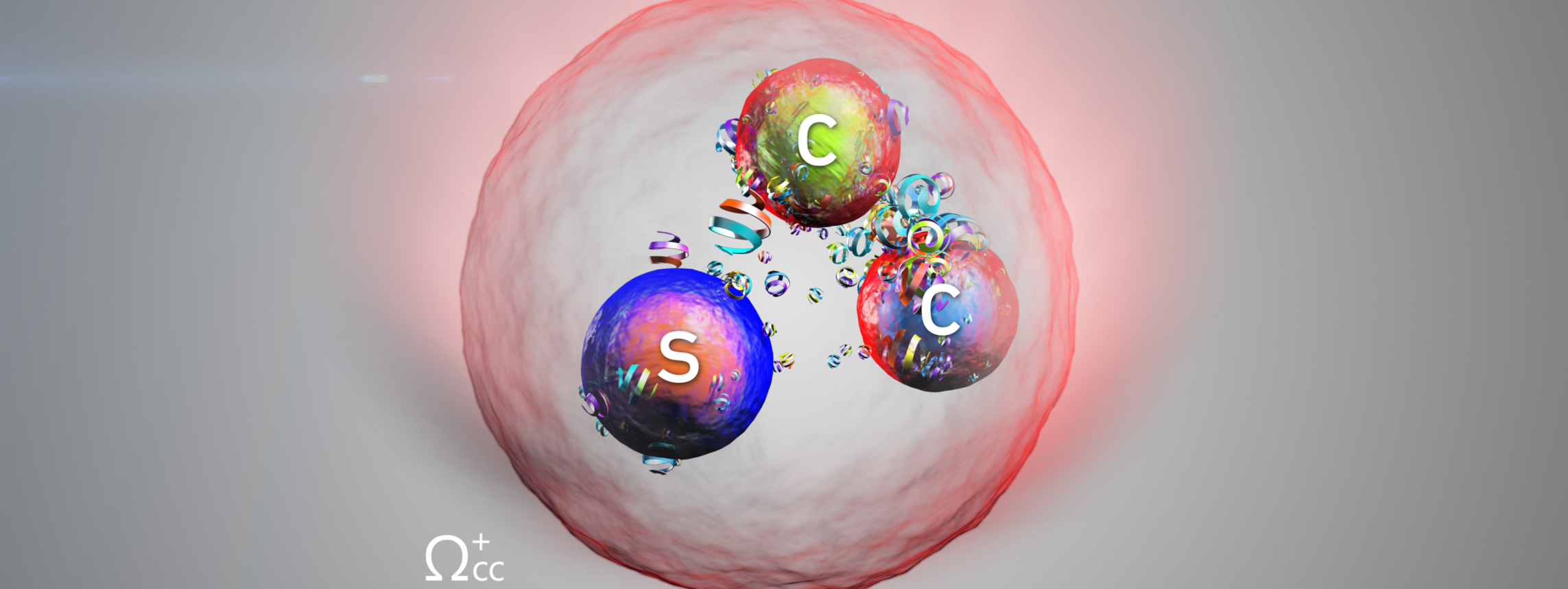
The LHCb Collaboration has found a new particle consisting of one strange quark and two charm quarks. With this finding, the Collaboration has discovered the final member of a family of doubly charmed baryons – particles made up of two charm quarks and one other quark – and closes a chapter of a story that stretches back more than sixty years.
Quarks are basic building blocks of matter. There are six types of quarks (up, down, charm, strange, top and bottom), which bond into pairs or triplets, known as mesons and baryons respectively. Sixty years ago, as experiments started to reveal the underlying quark structure of matter, researchers began to build theoretical models to classify how quarks can combine into composite particles. Soon, scientists were able to predict the properties of as-yet-undiscovered particles.
In 1964, the discovery of a new particle at Brookhaven National Laboratory marked a turning point. Consisting of three strange quarks, this particle had already been predicted by theorists, and the experimental confirmation of its existence and properties showed the strength of these theoretical models.
Ten years later, in 1974, another discovery rocked the world of particle physics
as it revealed a fourth quark, the charm quark. This meant that theorists now had to extend their models to accommodate the many new possible quark combinations. Included in these predictions were the doubly charmed baryons. These are particles that each consist of two charm quarks and either an up, a down or a strange quark as the third of the triplet. Physicists are particularly interested in this family of particles as the large mass differences between the quarks could provide useful insight into the strong force, which binds quarks together into composite particles.
However, the experiments of the time were neither able to produce the doubly charmed baryons, nor did they have sensitive enough equipment to detect them. For comparison, the landmark discovery of the particle consisting of three strange quarks in 1964 was made by searching through 80 000 photographs of particle collisions in bubble chambers. It would take the far higher energies of the Large Hadron Collider (LHC) and the combing through of trillions of particle collisions for researchers to begin to search for the doubly charged baryons in earnest.
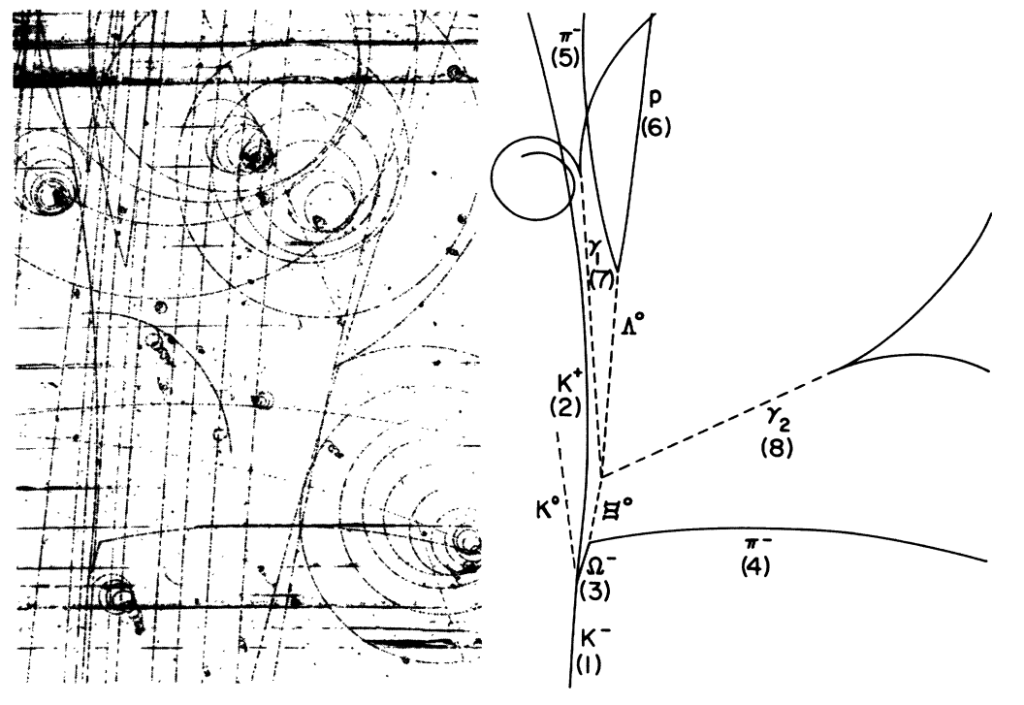
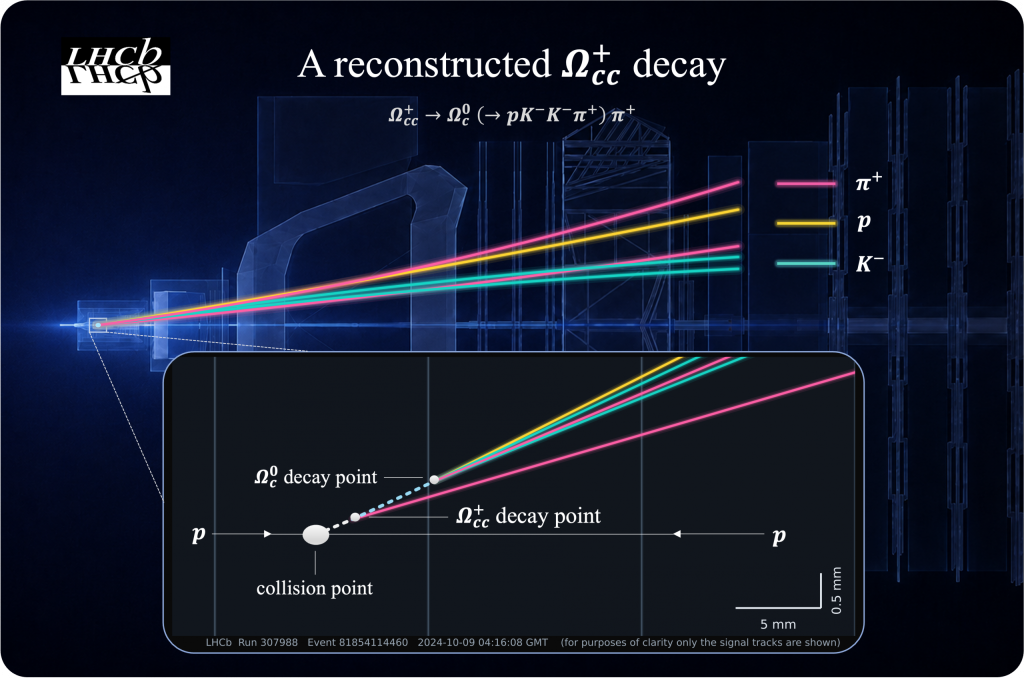
Comparison of the changing techniques of particle detection. Left: a photograph of the 1964 discovery of a particle consisting of three strange quarks using a bubble chamber (Image: Brookhaven National Laboratory). Right: a reconstruction of how the new particle of two charm quarks and one strange quark was created and detected at the LHCb experiment (Image: CERN).