
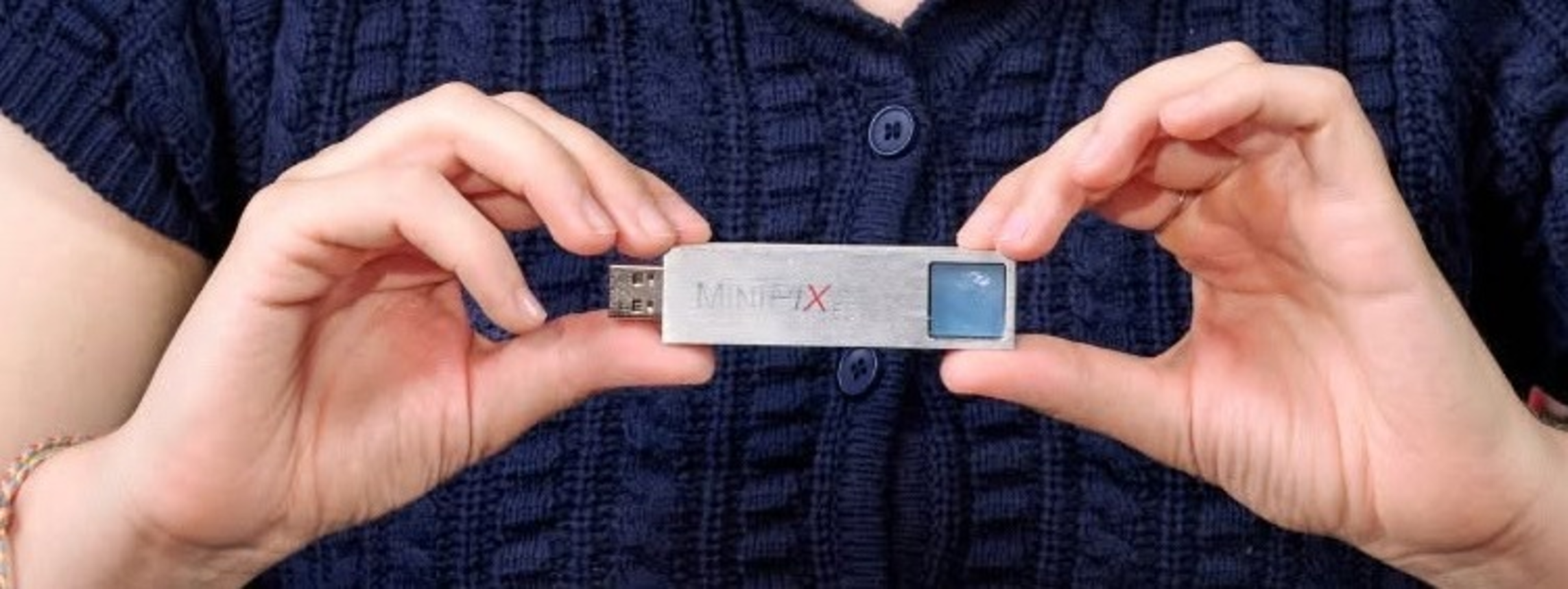
TIMEPIX@school: Bringing detector technology developed at CERN into classrooms worldwide
TIMEPIX@school is a new CERN-led initiative that will bring Timepix-based detectors, developed within the CERN Medipix2 Collaboration, into classrooms worldwide. With these detectors, students can visualise and analyse radiation in real time, turning abstract physics concepts into something tangible, interactive, and exciting.
Launching in the 2026–2027 academic year, the project aims to bridge the gap between school physics and real-world applications by giving students hands-on experience with the same technology used in high-energy physics, medicine, aerospace and art. By 2030, the programme is planning to reach approximately 20,000 students.
The technology
The Timepix chip is a silicon chip that is divided into a 256×256 grid of tiny pixels. When the Timepix chip is combined with a semiconductor sensor, it provides real-time images of ionising radiation.
The MiniPIX EDU detector is a compact, low-power radiation detector based on a single Timepix chip. The device connects to a computer via USB and works with user-friendly software, making it easy to integrate into classroom experiments.
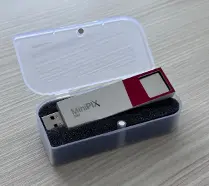
The MiniPIX EDU detector. Image: ADVACAM
With the software, students can identify different particle types, such as alpha particles, electrons, photons and muons, based on their characteristic tracks. They can also measure the energy these particles deposit in the sensor, helping them understand how they interact with matter. This provides a much richer and more visual experience compared to traditional Geiger counters.
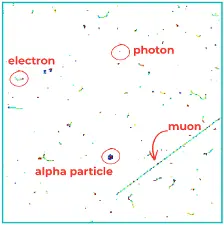
10-minute measurement of background radiation recorded with a
MiniPIX EDU detector. Image: CERN
Timepix chips are used in a wide range of scientific and societal applications in high-energy physics, medicine, aerospace, and art. TIMEPIX@school gives students access to this same technology, helping them see the real-world value and relevance of science.
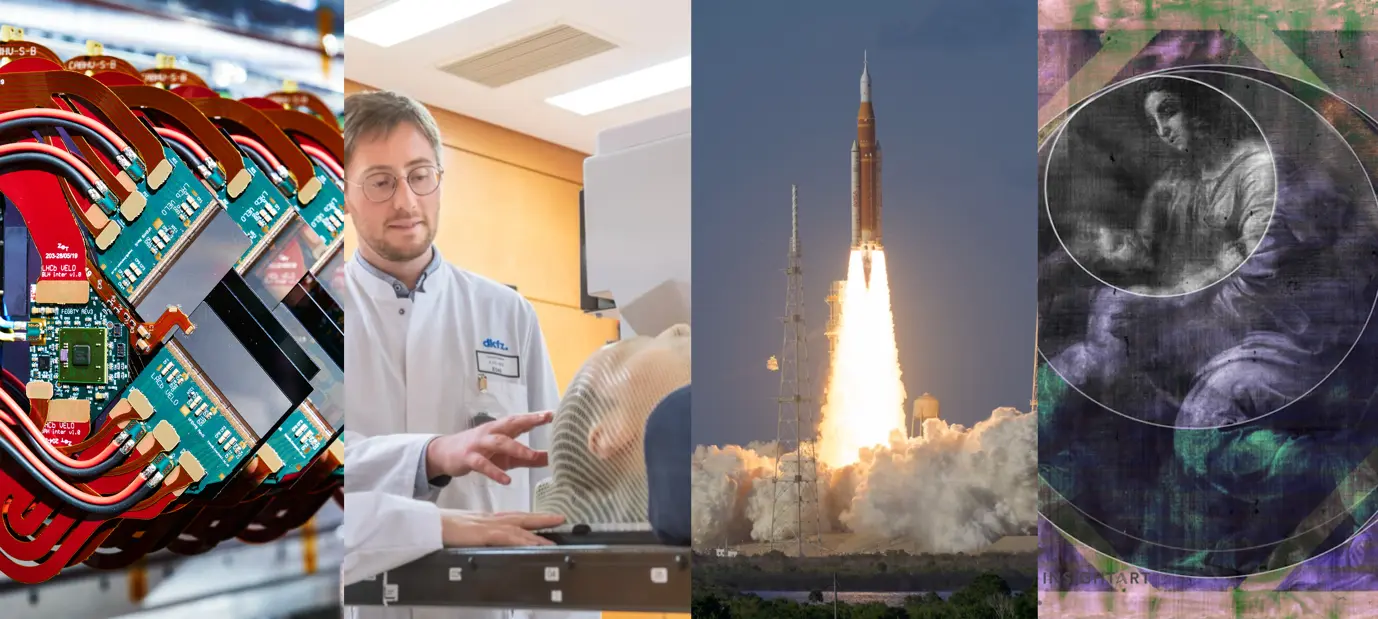
Use case examples of the Timepix chips in high-energy physics (VeloPix chip for the LHCb experiment), medicine (dosimetry for head tumour radiotherapy), space (dosimetry for NASA’s Artemis II Mission), and art (non-invasive analysis of paintings). Images, from left to right: CERN, Heidelberg University Hospital /H.Schroeder, NASA/Bill Ingalls, InsightArt
The TIMEPIX@school model
TIMEPIX@school will be based on a coordinated network of regional hubs located in schools, universities, institutes, or research centres. For the first year of the programme, hubs based in CERN’s Member and Associate Member States will be selected through a call for proposals open between 1 May and 15th of July. The reach of the programme is expected to expand across the globe in subsequent academic years.
Selected hubs will receive a loan of up to 10 Timepix-based detector kits at no cost, online training on the use of the kits, and access to a curated list of educational resources. The role of the hubs will be to adapt and translate these resources to the local curriculum and distribute the detector kits and educational materials to at least 3 partner schools in the area.
While CERN provides the technological and pedagogical foundation, hubs and teachers have freedom to design interdisciplinary or project-based activities, develop new experiments and measurement campaigns, collaborate across schools or with local research institutions, and integrate the technology in ways that reflect their students’ curiosity and needs.
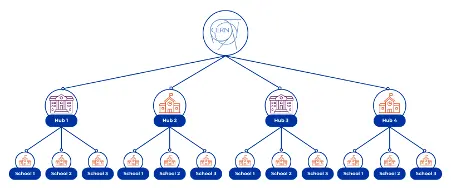
The TIMEPIX@school programme model. CERN selects hubs which then work with at least three partner schools in their area. Image: CERN
The impact
TIMEPIX@school aims to increase interest in STEM subjects by giving teachers access to radiation monitors that will in turn inspire their students to consider a future in the sciences.
For students, it aims to make science more accessible, relevant, and interesting. When students can see radiation, formulate their own questions, and work with real data, science becomes something they actively explore rather than passively receive. Unfortunately, many students don’t get to experience this aspect of science at school, where the emphasis is often placed on memorising facts to cover an overloaded curriculum.
Additionally, the visual capabilities of Timepix-based detectors can help overcome various misconceptions that students hold about radiation and radioactivity — for example, the idea that radiation is only artificial or inherently dangerous — by showing its natural presence in our environment and its many beneficial applications.
For teachers, the programme offers meaningful professional development opportunities, supporting them in increasing their confidence in teaching modern physics, diversifying their practice, and connecting more closely with current research.
More broadly, TIMEPIX@school seeks to expand access to high-quality STEM experiences to a wider range of students. This is why priority will be given to hubs working with schools in underserved and underrepresented communities, and those engaging female students. By bringing students in contact with scientists and modern research environments, the programme also aims to challenge stereotypes about who science is for and what scientists do. This is particularly important for students who may not identify with the image of scientists presented by today’s media.
Get involved
Institutions interested in participating in TIMEPIX@school are invited to apply through a call for proposals until 15 July 2026: https://timepix-at-school.web.cern.ch/call-for-proposals/
Supported by donors and partners through the CERN & Society Foundation, TIMEPIX@school is also actively seeking partners interested in supporting hubs in their region: https://cernandsocietyfoundation.cern/